You can now download an eBook that includes all of the six steps to preparing an academic article manuscript blog entries, several pieces on peer review and manuscript revision, and a few posts on converting a dissertation into a book manuscript! Maybe the era of the blog is officially over? And, if so, I’ll put together the content from this blog into a series of thematic eBooks. In the meantime, enjoy these slightly revised blog posts as chapters.
Academics have been complaining about the for-profit models of publishers like Elsevier, Sage, Wiley, Taylor & Francis, and Springer since I started my career as a graduate student in the early 2000s; it’s one of the reasons why my cohort of graduate students started an Open Access journal, reconstruction, in 2001! It’s a drag that they generate as much profit as they do off of the “free” labor of academics, who do all of the research, writing, and peer review that makes their journals run, but have you ever considered just not publishing with them?
Alt-text: A still from The Simpsons, in which Abe Simpson, Homer’s father, is pictured yelling at a cloud with his arm raised in a fist. “Old Man Yells at Cloud” is the headline of the accompanying newspaper article.
I’ve published with Sage, Taylor & Francis, and Wiley over the years and maybe there was a time when they could have argued that their model worked better to provide authors, editors, and peer reviewers with the kind of editorial support that made doing their jobs easier. That was never my experience–some of my worst peer review and publishing experiences were with for-profit publishers–but that would be a solid counter-argument to the obvious profit-seeking those publishers do. I’m not an apologist for the Big 5 for-profit academic publishers, but I’ve accepted over the years that getting my work in front of the right audience means publishing in a journal owned by a for-profit business.
The sad reality is that getting tenure is a numbers game, and getting the right number of articles and books published is the only goal. I’ve accepted needing to peer review for for-profit publishers because I recognize that other peoples’ careers depend on that labor. I also accept that the profits generated go to creating more journals and publishing books, all of which have the downstream effects of getting more scholarship into the world–and helping academics meet the metrics they need for landing jobs and getting promoted. It’s not ideal and I wish every university had a not-for-profit press that published journals across fields, but this is the late capitalist world we inhabit.
That being the case, journals get readers because they’re prestigious, for lack of a better term, and if people stopped submitting their work to journals owned by the Big 5, their rankings will drop. Academia is a massive ship and slow to change course. Getting the overwhelming number of scholars who don’t have a problem peer reviewing for and publishing in–let alone doing the editorial work of–journals run by the Big 5 to stop doing that work seems very unlikely. The likelihood that a sea change could actually occur in the prestige of the Big 5’s journals is rather low; they will continue to publish a lot of work in your field unless people start opting out of working with them.
So, you could just accept that making money for other people is an unavoidable part of the job–like generating tuition dollars off of students and their families and overhead costs through grant writing–or you can opt out of publishing with the Big 5. How do you do that?
Publish in University Press and Society-Run Journals: Many fields have journals that are published by university presses, which tend to be not-for-profit business that receive state monies through university budgets. There are massive publishers, like Oxford, that publish journals across the arts, humanities, social sciences, and sciences, and smaller publishers, like Duke, Minnesota, California, Texas, Chicago, and more. It likely won’t cost you any money to publish in these journals–unless you pay Open Access fees, if they have them–and they generate more funds through institutional and individual subscriptions (which helps support these publishers and their mission to publish books that help people get tenure!).
There are also Open Access journals published by many academic societies. Years ago, the Society for Cultural Anthropology moved to make their journal, Cultural Anthropology, society-funded and Open Access, and they’ve managed to keep it afloat since 2014. Similarly, Disability Studies Quarterly is funded by the Society for Disability Studies, and receives support from Ohio State Libraries, which publishes several other Open Access journals. You might need to be a member of the society, but the costs associated with that are likely significantly cheaper than paying Open Access fees at a large publisher. You can also consider publishing with publishers like Berghahn, that are committed to Open Access publishing.
Just Stop Publishing Articles: If you’re past tenure, and especially if you’re past full professorship, why are you still publishing journal articles? I’ve long thought that full professors taking up the limited amount of real estate for publishing articles in journals is a bad look. I recognize that reaching the right audience (and sometimes earning a raise) depends on maintaining a publishing presence. But as a full professor you likely already have a readership and can push out your own publicity regardless of where you publish–and your university probably doesn’t care too much if you’re publishing in a top tier or third tier journal. I’d even go so far as to say that publishing in a third tier journal is exactly what senior academics should be doing, since it helps to increase those journals’ prestige by driving citations (for better and worse).
Make Your Work Available for Free: Many state universities have agreements with for-profit publishers to allow their faculty to make their work published in for-profit journals available through public repositories, which Google Scholar will notify you about (and make available to people). If your university isn’t one of those universities, there is precedent in making this happen and working with your librarians and faculty senate might secure a better, Open Access future for your faculty. But you can often also post pre-print versions of your work on your own website or through services like ResearchGate and Academia.edu (if you want to aid their attempts at capitalization)–or you can post the actual copy of the article or book chapter and take it down if a publisher gets upset about it.
None of these are Seize the Means of Production! level suggestions, but failing the ability to meaningfully change the way academic publishing works, they are options that can support other models of publishing and dissemination. The next time you feel yourself itching to publish in a Big 5 journal, take 30 minutes and investigate whether there might be a university press or society-run journal you might publish with instead.
Maybe one day for-profit academic publishers will start paying their authors, peer reviewers, and editors, but I doubt it. It’s too profitable not to, and relying on the conservative nature of many academics invested in prestige economies is a super safe bet–maybe the safest! Even if publishers start to pay their contributors, it will likely never feel sufficient to the work that people do to support the journals. Instead, maybe the warm feeling of publishing in an Open Access, university press journal will suffice?
In one of the first meetings I had with my dissertation adviser, Karen-Sue Taussig, she recommended that I read Catherine Lutz’s “The Gender of Theory” and “The Erasure of Women’s Writing in Sociocultural Anthropology.” (If you haven’t read them, go read them right now.) Lutz makes two interrelated points: despite the number of women working in sociocultural anthropology, they tend to get cited less frequently than men, and when they are cited, they’re cited as providing empirical evidence that supports an argument rather than theory that can be tested or employed. (And if you think that was a problem of the 1980s and 1990s, you can read the follow-up, “The Problem of Gender and Citations Re-raised in New Research Study” [although the link doesn’t seem to be working…] and then mull over what’s really going on in pieces like this.) At the age of 25, and a few years into my graduate studies, I might have been in just the right frame of mind for such an intervention. It resulted, immediately, in a hyperawareness of my citational practices — and shaped the kinds of questions and projects I wanted to pursue.
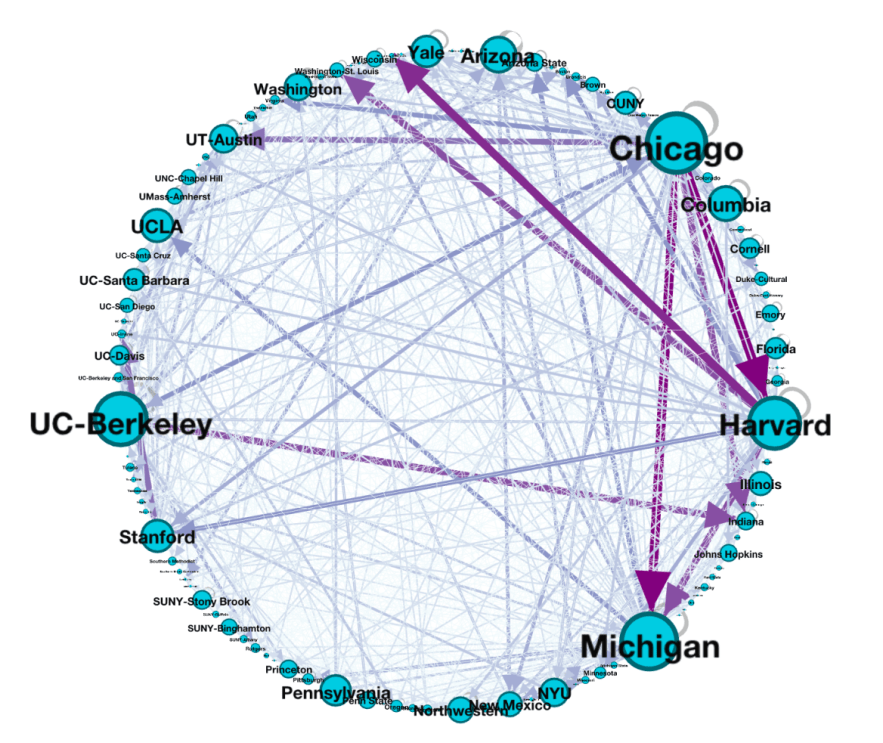
One of those projects has been steadily diversifying the network, both personally and professionally. In 2017, I was asked to comment on an early version of Nick Kawa, José A. Clavijo Michelangeli, Jessica L. Clark, Daniel Ginsberg, and Christopher McCarty’s “The Social Network of US Academic Anthropology and Its Inequalities,” and reading its final version was a stark reminder of just how much work is to be done. If you ever wanted evidence of that, here’s Kawa et al.’s data rendered in one handy image:
A network analysis of Ph.D. placements of tenure-track faculty based on where their degree originates and where they were hired. See more here.
Here are some practices to consider if you want to disrupt the reproductive tendencies of the discipline at every level. My guiding principle is that power is meant to be subverted, and whatever meagre institutional and reputational power I have should be used to make more inclusive social and institutional networks.
Every year when I’m pulled back to the American Anthropological Association meetings, I make sure that I participate in two panels. One has to include a majority of people who I’ve never been on a panel with before; and one has to include at least 50% recent Ph.D.s (or in-progress ones) and contingent faculty or “independent scholars.” Sometimes both of the panels meet both of the criteria. I’m not sure that I have much draw on my own, but whatever draw I have should be shared with less secure or established scholars than myself. Beyond that, I want to be exposed to ideas and research that I wouldn’t otherwise encounter. I can read my friends’ work any time, but curating a panel with strangers on a topic of my choice lets me engage with new content and publicizes it for others. It also means that my network grows in these AAA-related spurts, and I’ve watched my network permanently diversify over the years through this practice.
If you keep having the same conversation with the same people, something is wrong. Even if those people are diverse, if the network stabilizes, it’s not being as inclusive as it could be. It can be hard to exclude old friends from conferences, workshops, special issues of journals, whatever, but if the collective project is to diversify the network, they should be doing the same thing to you. And this leaves you open to be included in other people’s efforts. Stale networks are pretty obvious, both from the inside and the outside. My guiding rules are a place to start to disrupt reproductive tendencies, and I’m sure that employing them will help refine a system that works for other people.
If someone asks me to do something and I can’t, I suggest a junior scholar or someone at a non-elite institution (or both). If I can’t do something — a talk, peer review, a conference panel, whatever — I always try and make sure that I provide at least three names of people who might fit the role. My preference is always for younger people than me, although I’m very sensitive to my ability to say “no” and the obligations younger scholars fell toward saying “yes.” That said, I will commit to doing something even as over-commitment if I know that the next person to be asked is someone who isn’t as diversity-focused as I am. Better a white person with an eye towards diversification than one who isn’t diversity focused (or at least that’s how I console myself).
I don’t just count citations; I also consider how a citation is being used. This is true for syllabuses and publications. I tend to start syllabuses by piling up books and articles that I’m sure I want to include in a class, and at that point make sure that the foundation of the class is diverse (i.e. at least 50% books by women, with attention to minority status ensuring that 50% of the books are also from authors from underrepresented backgrounds). After I put the rest of the syllabus together, I go through it and make sure that it’s diverse throughout. In cases where I have to include a dead, white, male writer, I make sure that the texts around that person are by other kinds of writers. I tend to make sure that 60% of a syllabus is comprised of non-white male contributors. I also try and make sure that theory and evidence are supplied equally by all of the contributors to the syllabus. (If you think that teaching the canon means only teaching dead white guys [or living ones], just remember that it’s not in the canon if it hasn’t reached the point that non-white, non-male scholars are discussing it!)
In terms of publications, I tend to make a first pass through the manuscript citing as few people as I possibly can. Part of that is pragmatic — I don’t want to get hung up on inserting citations, and if there’s a lot of new stuff I’m planning to cite, I prefer to do all of the data entry and management during the revision process. But the other part is that I learned in the past that I over-cite. I would tend to cite too many things and then have to remove them to reach the word limit I was shooting for. I found that having to remove citations was harder than having to put them in afterwards, and that working this way helped to see who I really needed to cite. Moreover, it meant that when I was inserting citations, I could be more deliberative about who I was citing for what. Like with my syllabuses, when I do have to cite a dead white guy, I try to ensure that the citations around him are more diverse. And when I have to engage with a lot of white guys, it’s usually because I’m doing some critique…
All of these citational practices are aspirational, and I’m sure that not all of my publications meet the criteria I’ve set for myself over the years. That might be hypocrisy, but it’s also due to requests from peer reviewers and editors to cite certain work and the stark reality that working in some corners of academia means there are limited sets of scholars to engage with. The solution to the latter is to develop frames for one’s work that are capacious and bring in perspectives from feminism, critical race studies, disability studies, class-focused research (not just Marxism), and postcolonial studies. The solution for the former — sometimes — is to just not cite those people, despite requests (which gets easier to do with seniority).
When serving on hiring committees, one of the implications of Kawa et al.’s research is the need to make sure that the committee is institutionally diverse. One sure way to at least contest the dominance of particular departments in the placement of Ph.D. holders into tenure track jobs is to have people who aren’t from those institutions serving on hiring committees. If your department lacks people that fit this criteria, have a faculty member from another department serve in a non-voting, consultative role. I served on a committee like this years ago, and it was helpful because the person from outside of Anthropology couldn’t have cared less about the institutions that people were coming from since his discipline had different elite institutions; he helped to focus other committee members’ attention beyond institutional backgrounds. If that sounds uncomfortable, you could have someone go through all of the applications and redact institutions, people’s names, and acknowledgement sections. (If there isn’t an Adobe macro for this, there should be…)
I’m convinced that underlying a lot of the resistance to change in the academy is a fear of being displaced in the present and the future, especially in the context of fears about the end of the tenure system and job scarcity. Wholesale displacement is unlikely, but some marginalization is inevitable. But that’s in relation to a century and a half of dominance in the university by white, male voices, so it’s relative to total dominance. Incrementalism can get a bad rap, but when the allies in power are faced with their own potential obsolescence, a gradual approach can make important headway while ensuring that the threats to individuals are mitigated. Changing institutions is a long game, and keeping the end point in mind while addressing the concerns of the present is one way to ensure that change will come, however gradual it might be.
These practices are a start towards diversification. If you have other suggestions, post them in the comments or provide links.

 Matthew Wolf-Meyer