The Ethnographic Clinic, Part 1: Presenting the Case

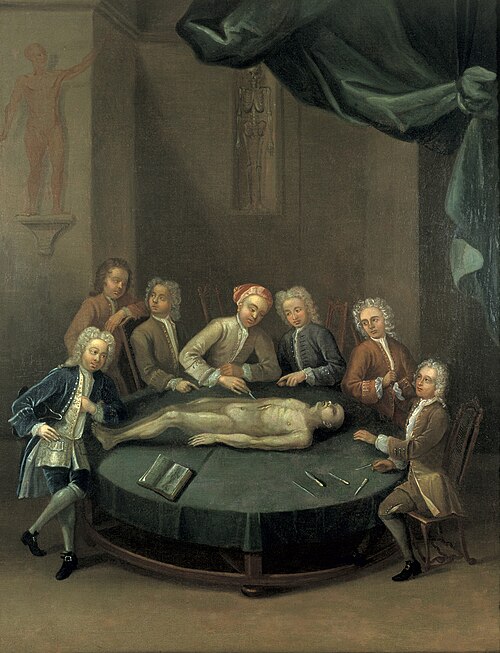
William Cheselden giving an anatomical demonstration to six spectators in the anatomy-theatre of the Barber-Surgeons' Company, London. Oil painting, ca. 1730/1740.

Ethnographic writing is composed of cases. Ethnographers don’t always think that way about their research, but what they are collecting are descriptions of events, processes, and interactions; interviews with individuals or conversations with groups; and reflections on experiences based on participant-observation. Cases can be singular, e.g., a specific, one-off event, or processual, e.g., a series of interactions with someone over time. The trick in ethnographic writing is to clearly isolate cases as cases and then to scale up from an individual case to an analysis that demonstrates the representativeness (or exceptionality) of a case.

I come to this characterization of ethnographic cases because of my time in a teaching hospital, where clinicians and clinical residents presented thorny cases to their shared department in the hopes that they could come to some collective understanding of the case. Often, they presented the department staff with just the facts: what a patient’s symptoms were, what the social context of the patient was, and how the patient had been treated previously and to what effect. Rarely, cases were presented with an anticipated interpretation or resolution; instead, interpretation was something that was solicited from the group.

In that context, I’ve begun to wonder whether a similar approach to ethnographic writing might work: instead of expecting interpretation to come through isolated, scholarly attention to one’s ethnographic research, might collective rumination about other people’s ethnographic cases open up interpretive possibilities and aid in the writing process? Over this and two other posts, I articulate the Ethnographic Clinic as an experiment in ethnographic writing. This post lays out the first stage of this process: identifying and writing up a case (which echoes an earlier post about the 5-Page Dissertation); the second stage scales up from the individual case to contextualize it; and the third stage elaborates how to make an analytic turn to do the interpretive work that ethnographic writing requires.

Step One: Tell a Thorny Story

Every ethnographer has experiences during their fieldwork that stick with them and that they continue to think about without neat resolution. These experiences can be interviews, events or interactions, or observations of practices and processes. For the purpose of the Ethnographic Clinic, choose one thorny story and describe it in as much detail as possible. Withhold analysis. It can be as short or long as needed, with the aim of conveying to the audience only what they need to know to understand the case. Who was involved? Where in the world is it occurring? How do things unfold? The case, to the degree that it’s possible, should have a beginning and an ending, but what that consists of should be determined by the case itself.

The story should be temporally limited. That is, if there is a re-occurrence of the event or interaction, limit yourself to just one occurrence. If it is an interview, it shouldn’t be the whole interview, but only the parts that are key to the case.

Refuse analysis. If you’re tempted to start to explain anything, either contextually or analytically, stop. The aim is just to describe the case. Any analysis will disrupt the next step, so be sure to keep the case as empirically-focused as possible. If you need to, have someone else edit out any analytic or contextualizing work you do.

Step Two: Present the Case

Find a clinic. What that entails is bringing together several other ethnographers who are also working on cases that they can present to a shared audience (that they should also be part of). When you present the case, stick to the text. Then, spend time addressing audience questions and allowing the audience to reflect on the case. It may be useful to have someone else keep notes of this conversation and to audio record it as well. What contextual questions do people have? What do you need to tell them that they haven’t already learned from the case in order for the case to make sense? What kinds of theoretical connections are they making? How are they interpreting the case and to what end? What it is as case of, as far as they understand it, either within your work, their work, or the work of other scholars? Be sure to spend ample time with each case–maybe 30-40 minutes–and to not rush to ready conclusions, but to let the audience respond to the case and provoke your further reflection on the case.

Step Three: Outline Next Steps

From the clinical presentation, you should have a list of contextualizing information that your audience needs, theoretical points of connection and frameworks, and a growing sense of the other research you have done that this case connects to. Organize this as an outline with those three headings: contextualization needed, theoretical connections, and additional research. In the next stage, you’ll focus on the first and third of these elements in order to flesh out this first case. Approaching this outline as an enumerated list of what needs to be done is the most robust approach, as it will help guide you through the next stage of the writing process.

Stage two proceeds from here.

Six Steps to Academic Article Writing–From Blog to eBook!

You can now download an eBook that includes all of the six steps to preparing an academic article manuscript blog entries, several pieces on peer review and manuscript revision, and a few posts on converting a dissertation into a book manuscript! Maybe the era of the blog is officially over? And, if so, I’ll put together the content from this blog into a series of thematic eBooks. In the meantime, enjoy these slightly revised blog posts as chapters.

The free eBook for the six steps to preparing academic article manuscripts is here (I hope) or you can buy it for 99 cents from Amazon (if you really want it as a kindle).

Academics: Opt Out of For-Profit Publishing Extraction, Already!

Academics have been complaining about the for-profit models of publishers like Elsevier, Sage, Wiley, Taylor & Francis, and Springer since I started my career as a graduate student in the early 2000s; it’s one of the reasons why my cohort of graduate students started an Open Access journal, reconstruction, in 2001! It’s a drag that they generate as much profit as they do off of the “free” labor of academics, who do all of the research, writing, and peer review that makes their journals run, but have you ever considered just not publishing with them?

Alt-text: A still from The Simpsons, in which Abe Simpson, Homer’s father, is pictured yelling at a cloud with his arm raised in a fist. “Old Man Yells at Cloud” is the headline of the accompanying newspaper article.

I’ve published with Sage, Taylor & Francis, and Wiley over the years and maybe there was a time when they could have argued that their model worked better to provide authors, editors, and peer reviewers with the kind of editorial support that made doing their jobs easier. That was never my experience–some of my worst peer review and publishing experiences were with for-profit publishers–but that would be a solid counter-argument to the obvious profit-seeking those publishers do. I’m not an apologist for the Big 5 for-profit academic publishers, but I’ve accepted over the years that getting my work in front of the right audience means publishing in a journal owned by a for-profit business.

The sad reality is that getting tenure is a numbers game, and getting the right number of articles and books published is the only goal. I’ve accepted needing to peer review for for-profit publishers because I recognize that other peoples’ careers depend on that labor. I also accept that the profits generated go to creating more journals and publishing books, all of which have the downstream effects of getting more scholarship into the world–and helping academics meet the metrics they need for landing jobs and getting promoted. It’s not ideal and I wish every university had a not-for-profit press that published journals across fields, but this is the late capitalist world we inhabit.

That being the case, journals get readers because they’re prestigious, for lack of a better term, and if people stopped submitting their work to journals owned by the Big 5, their rankings will drop. Academia is a massive ship and slow to change course. Getting the overwhelming number of scholars who don’t have a problem peer reviewing for and publishing in–let alone doing the editorial work of–journals run by the Big 5 to stop doing that work seems very unlikely. The likelihood that a sea change could actually occur in the prestige of the Big 5’s journals is rather low; they will continue to publish a lot of work in your field unless people start opting out of working with them.

So, you could just accept that making money for other people is an unavoidable part of the job–like generating tuition dollars off of students and their families and overhead costs through grant writing–or you can opt out of publishing with the Big 5. How do you do that?

Publish in University Press and Society-Run Journals: Many fields have journals that are published by university presses, which tend to be not-for-profit business that receive state monies through university budgets. There are massive publishers, like Oxford, that publish journals across the arts, humanities, social sciences, and sciences, and smaller publishers, like Duke, Minnesota, California, Texas, Chicago, and more. It likely won’t cost you any money to publish in these journals–unless you pay Open Access fees, if they have them–and they generate more funds through institutional and individual subscriptions (which helps support these publishers and their mission to publish books that help people get tenure!).

There are also Open Access journals published by many academic societies. Years ago, the Society for Cultural Anthropology moved to make their journal, Cultural Anthropology, society-funded and Open Access, and they’ve managed to keep it afloat since 2014. Similarly, Disability Studies Quarterly is funded by the Society for Disability Studies, and receives support from Ohio State Libraries, which publishes several other Open Access journals. You might need to be a member of the society, but the costs associated with that are likely significantly cheaper than paying Open Access fees at a large publisher. You can also consider publishing with publishers like Berghahn, that are committed to Open Access publishing.

Just Stop Publishing Articles: If you’re past tenure, and especially if you’re past full professorship, why are you still publishing journal articles? I’ve long thought that full professors taking up the limited amount of real estate for publishing articles in journals is a bad look. I recognize that reaching the right audience (and sometimes earning a raise) depends on maintaining a publishing presence. But as a full professor you likely already have a readership and can push out your own publicity regardless of where you publish–and your university probably doesn’t care too much if you’re publishing in a top tier or third tier journal. I’d even go so far as to say that publishing in a third tier journal is exactly what senior academics should be doing, since it helps to increase those journals’ prestige by driving citations (for better and worse).

Make Your Work Available for Free: Many state universities have agreements with for-profit publishers to allow their faculty to make their work published in for-profit journals available through public repositories, which Google Scholar will notify you about (and make available to people). If your university isn’t one of those universities, there is precedent in making this happen and working with your librarians and faculty senate might secure a better, Open Access future for your faculty. But you can often also post pre-print versions of your work on your own website or through services like ResearchGate and Academia.edu (if you want to aid their attempts at capitalization)–or you can post the actual copy of the article or book chapter and take it down if a publisher gets upset about it.

None of these are Seize the Means of Production! level suggestions, but failing the ability to meaningfully change the way academic publishing works, they are options that can support other models of publishing and dissemination. The next time you feel yourself itching to publish in a Big 5 journal, take 30 minutes and investigate whether there might be a university press or society-run journal you might publish with instead.

Maybe one day for-profit academic publishers will start paying their authors, peer reviewers, and editors, but I doubt it. It’s too profitable not to, and relying on the conservative nature of many academics invested in prestige economies is a super safe bet–maybe the safest! Even if publishers start to pay their contributors, it will likely never feel sufficient to the work that people do to support the journals. Instead, maybe the warm feeling of publishing in an Open Access, university press journal will suffice?