So You’ve Got a Ph.D. in Anthropology…

Okay, let’s assume the worst. You’ve spent the last 5-10 years focused like a laser on researching and writing your dissertation. You haven’t attended any conferences, let alone presented any of your research. You haven’t taught any courses, and maybe haven’t even served as a teaching assistant. You haven’t published any of your research. When you’ve talked to your committee members about preparing for the job market, they’ve dismissed your concerns telling you that “everything will work out” and “you don’t need to worry about it.” And now here you are, Ph.D. in hand, dissertation behind you, and the yawning chasm of adult professional life gaping before you…

Made in Abyss - 09 - Large 12.jpg
That’s a cat abyss.

So, the bad news: unlike during the fantastic world of yesteryear, there are no ready jobs waiting for you now that you’re credentialed. The slightly better news: there’s a lot you can do to make yourself appealing to potential employers, in and out of the academy. And the best news? There are many possible professional paths your Ph.D. has prepared you for, but it will take a lot of work to prepare for applying to those jobs.

Now, hopefully you already know all of this, and you’ve spent the last several years preparing yourself for the kind of job you are interested in, whether in the university system or outside of it (or maybe both). One of the best things you can do as you prepare to go on the job market — say a year or two out — is to start paying attention to job advertisements. Ads list the kinds of qualifications that they’re looking for, from specializations (teaching methods and intro, especially, as well as courses in your area) to the kinds of documents that they require (graduate transcripts, teaching statements, CVs or resumes, writing samples, syllabuses, and more).

If you’re looking at jobs outside of the university system, they’ll likely be looking for other kinds of documentation: white papers, policy documents, portfolios, etc. The best preparation for these paths is to complete coursework in relevant areas, if not actually achieve accreditation (like getting a Master’s degree in Public Administration, Public Health, or Museum Studies, for example). Beyond helping acquaint you with professional genres, they should also help to develop professional networks in the right areas. If you’re really on the ball, you can complete these degrees alongside your coursework for your Ph.D., using whatever tuition waiver you might have to cover the cost of enrolling in these complementary courses. But you might also have to go back to school to get these credentials and develop new professional networks.

In 2015 I ran a professionalization workshop with current graduate students and alumni who had moved into non-academic careers. The collected professionals painted a relatively positive picture of moving into careers outside of the university. One of them pointed out that in the university system, almost everyone has a Ph.D., making it a rather banal credential; outside of the university, a Ph.d. is treated totally differently, and coworkers respect the expertise that it represents. They also pointed out how a lot of Ph.D. students think that they’ve been deskilled, but that the kinds of skills one learns as a graduate student can be translated into desirable workplace competencies. “Teaching” is “Public Speaking,” “Writing a Dissertation” is “Copyediting” and “Research-based Writing,” and “Finishing a Dissertation” is “Research Management.” Then there are skills like grant writing and data management (all that data sorting and labeling) that you might have picked up along the way. After spending thousands of hours researching and writing a dissertation, you have more skills than you might think; but, as these professionals helped to make clear, academics don’t tend to think of all of the skills they have as marketable proficiencies.

That said, there might need to be an intermediary step to hone those proficiencies into actual skills that produce deliverables that employers can do something with. And there are opportunities like Congressional Graduate Recruitment Program that seek to do just that. There are also organizations, like RAND, that hire qualitative researchers — as do many of the think tanks and policy organizations in Washington D.C. (you just have to be cool with doing research on topics that other people determine, and, potentially, stomach their politics as well).

Over the last several years — thanks to the Great Recession and the blogosphere — there has been growing attention to the exploitative and demoralizing political economy of adjunct labor in the university system. If you’re not aware of what people have been saying, it boils down to this: there are fewer full time, tenure line jobs than there were before, and to meet enrollment demands, more part-time laborers are being hired to offer courses. These adjuncts tend to teach on limited contracts (one semester or one year), lots of courses, and for little pay — often a fraction of what faculty are paid for the same course. Sometimes, rather than adjunct labor that looks like this, it can come in the form of a Visiting Assistant Professorship or even a postdoctoral position, both of which may be better, since they likely offer benefits on top of the salary. Beyond the obvious bummer of being low paid for the same job, and having lots of work to do — which often is very intro-level focused — adjuncting can create a lot of anxiety as people struggle to secure future employment, and there’s not a lot of time to produce the stuff that would make one appealing for full-time positions (which is sometimes referred to the “adjunct trap”). If you find yourself in the adjunct trap, you’ll need to engineer a way out, which may mean refusing work in the short term in order to prepare yourself for a long term career (which may mean going back to school to get another degree).

If you’re interested in pursuing alternative to academic careers (sometimes shortened to “alt-ac”) there are growing resources to help Ph.D. recipients to navigate the divide between the university and other career possibilities. One of the challenges that job seekers face is confronting assumptions about what policy jobs or market research look like on an everyday basis. If you’ve spent the last however-many-years essentially being your own boss and working alone, many professional careers mean being managed and working with actual coworkers. Friends who have made the jump into these kinds of jobs report being surrounded by great, creative people — just as smart as any academic, but skilled differently.

So, hopefully you’re reading this as an early graduate student (or before enrolling in graduate school) and can take the time to plan appropriately. A recent conversation hosted by the Society for Cultural Anthropology on academic precarity got me thinking that it was about time for a post like this, since the initial foray on the topic made it seem as if it was a real shock that getting academic jobs is hard and that there are very few out there. I had also heard from a friend that she had witnessed a group of recent Ph.D.s openly fret about the prospects of going on a bleak academic job market since they hadn’t been prepared for the reality of it, and thought they might just jump into some alternative career — which is sure to be a rude awakening.

You might beat the odds and get one of the few academic jobs available in any given year. If so, remember that just as much as it’s about your hard work, it’s also about contingency, and that it’s important to make sure that the world of the university is more open to promoting diversity and fair hiring practices — as opposed to yesteryear (which largely favored white men from elite institutions). For everyone who works in the university system — faculty, staff, administrators, adjuncts, students — we need more attention to what makes desirable job candidates and support for creating more full time employment opportunities.
The Best Advice I Have to Give about Qualifying Exams

One of the disciplinary traditions of graduate study is the exam which allows a student to advance to candidacy. In theory, it’s not a bad idea: a little ritual to help indicate to your committee that you know the intellectual terrain well enough to get into your research and writing full time. In reality, the process tends to be obscure, and, for many students, can become an enormous source of anxiety. I benefited from a committee that provided a lot of structure for my exams, and so if you have a committee that isn’t particularly structuring (or even if you do), some of these practices might help. Qualifying exams are really just another test — and, if you’re lucky, they’ll be the last tests you ever take.

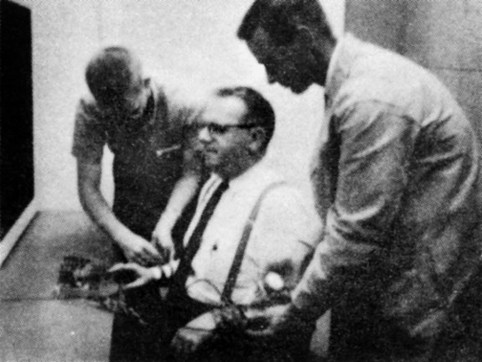
Milgram
Is it wrong to use an image from the Milgram experiments to talk about qualifying exams?

I’ve experienced two different forms of qualifying exams (or comprehensive exams, or whatever else they might be called): the timed exam and the open-ended exam (or the acute and the chronic). The first comes in a couple different varieties — sit in a room for a day or more and answer a question (or set of questions) or sit at home for several days and answer a set of questions. The second comes in a couple forms too — write a literature review of a set of texts or write a chapter or two of your dissertation (which are based on a set of predetermined readings). In each case, the exams are based on a collection of readings that have been determined by the student and the exam committee, with more or less direction.

I’m a big proponent of the ‘several questions over several days’ method of testing for a couple of reasons: short exams tend to be not very productive for the testee, and they tend to not be very good to read for the testers. The result is that they tend not to be especially indicative of what a person actually knows — just what they can cram into a one-day writing session. I’m also not a big fan of either of the open-ended options: they tend to drag out forever, leading to students taking a long time to advance to candidacy, in no small part because the implicit expectation is that they will in fact be ‘comprehensive’ (which is impossible). In both cases, students end up turning in exams that don’t do enough because they can’t — or which try to do too much without actually needing to. But that’s all neither here nor there — in any case, you have a reading list to generate…

Making the Reading List

Your reading list will be made of a certain number of readings as proscribed by your committee, and that list will be broken up into a set of smaller topical and thematic lists (usually 2-3). Usually, these lists are also keyed to a specific member of your examining committee, who is tied to the list (and your exam) by a shared speciality. So try this:

First, go through all the syllabuses from the graduate (and maybe undergraduate) classes that you’ve taken (you did keep them, didn’t you?), and come up with a list of all the topically and theoretically important stuff that you’ve already read. There might be additional stuff on these syllabuses that you haven’t read, but you should, and so this would be a time to do so.

Second, come up with a list of all the stuff you feel like you should know for your exams. This can be theoretical stuff, topical stuff, greatest hits from your discipline, historically important stuff for your specific field, etc. If you aren’t sure where to start, take a look at the Annual Reviews website and read through some review essays on topics related to your dissertation — they can be a great source of citations to mine. If you haven’t taken classes related to your dissertation topic, you can email professors who have taught relevant courses at your institution and other institutions and ask for syllabuses, which are also a good source to mine for citations.

In both cases, you don’t want your list to be too specific. I recommend to students that they should think about the classes that they’ll eventually teach and come up with syllabuses for them — they should be populated with texts that you would include on your reading lists. Most people don’t go through their careers teaching highly specialized courses, i.e. I don’t teach classes on sleep medicine in the 20th century; I teach classes on medical anthropology and the biology of everyday life. ‘Sleep medicine in the 20th century’ is too narrow for a exam list, but ‘medical anthropology’ of ‘the biology of everyday life’ would be good places to start.

Now, take the list of readings and sort them into thematic and topical clusters. Try and get each reading into two or more clusters, and try and make sure that each cluster has at least five readings in it. If a cluster doesn’t have enough in it, cut the cluster. If a reading can’t fit into at least two clusters, put it on a reserve list — don’t cut it, since it might be important, but put it into storage.

To make this a little more concrete, here’s a pretend dissertation to work with: nationalism in South Asian superhero comics, with fieldwork focusing on their creators and fans. (If you want to write this dissertation, let me know: I have a box of Indian comics waiting for the right graduate student.) So, to start with, our imaginary graduate student is going to have a few obvious clusters: South Asia as a topical region, theories of nationalism, and studies of popular culture, its creators and fans. There are going to be readings that fit into more than one of these clusters right off the list — readings about nationalism in South Asia, readings about popular culture in South Asia, and readings about nationalism and popular culture.

But each of these clusters is going to be comprised of a bunch of smaller clusters, so, for example, the popular culture cluster can probably be broken down in relation to kinds of media (film, novels, newspapers, TV, comic books, music, etc.). It might also be broken down in relation to the topical approaches of the authors, so you might have clusters focusing on race, gender, sexuality, class, etc. The student might also have clusters around fandom and creator-oriented approaches.

Again, you should be able to sort readings into multiple clusters. For the first draft of your reading lists, it’s not bad to have the same reading appear more than once (as long as your committee knows that you’re doing and not try and artificially inflate your reading list). At this point, it’s worth going back to the Annual Reviews database and looking for reviews of each of these clusters, and again mining them for citations. At the end of this process, you should have a pretty significant list of readings.

Once you have your clusters in place, it’s time to check in with your examining committee. What they should be doing is offering suggestions on other readings to fit into each of the clusters — and they might want to remove some stuff as well. Committee members can be especially helpful in identifying recently published stuff that may not have made its way into Annual Review essays yet, and they might also know scholars working in your field that are under recognized.

These suggestions from your committee should move your lists to being pretty finalized, and at this point you should work on organizing your clusters into their master lists and removing redundancies. (But you might keep a master list of your clusters so you can see where readings crossover into other clusters, which may be helpful as you write your exams.) You might also find that your list topics change in this process — that our imaginary graduate student moves from lists on South Asia, nationalism, and popular culture, to ‘nationalism in South Asia,’ ‘ethnicity, gender, and religion in popular culture,’ and ‘theories of mediation.’ (Frankly, any of the starting points of these lists was too broad to begin with — they should narrow and deepen as you work on them.)

With your finalized lists in hand, it’s helpful to write introductions to each of the lists. These introductions should be short, say 4-7 pages, and will lay out what your interests are in the overall topic of the reading list as well as the individual clusters that comprise the list. These introductions are helpful first stabs at thinking systematically about how the clusters in the list work together and what continuities exist within and across them; they are also very helpful for you committee, who may use your introduction to come up with questions for your qualifying exams. These introductions also help to serve as a guide for you as you do your reading, which, as you get into it, might start to feel overwhelming. But, if you know why you’re reading what you’re reading, your introductions can focus your attention to key questions and concerns in the texts.

Remember that your reading list is a contract with your committee: you can’t be held responsible to know anything not on the list, so when it comes time to write your exams or discuss them during an oral defense, know that the exam limits your committee too — at least in terms of what they can choose to ask you about and expect you to meaningfully engage with. If someone asks you something about a text that’s not on your list, it’s okay to say ‘I don’t know, but I’ll look it up.’

Reading & Writing the Exams

When it comes to the actual reading, it’s helpful to break the texts into two groups: things you need to spend a lot of time with and things that you can read in a cursory fashion. The cursory stuff might be things that you can read the introduction and a chapter or two from just to get a sense of where the author is coming from, where the project fits into the literature, and what the project looks like. You probably shouldn’t spend more than a day with any of the cursory material. In terms of the more intensive stuff, you’ll want to plan on reading it in its entirety and taking careful notes, with the expectation that you might spend two or three days with it. Ultimately, what you want to be able to do is identify similarities and differences between the approaches taken by authors — to that end, you should work on grouping authors and texts so that when it comes time to write answers to the questions you’re given, you can summarize kinds of approaches and trends in the field (it’s also helpful to plot historical transformations and continuities in how topics have been thought about).

I can’t imagine what your committee will ask you by way of exam questions, but, generally speaking, what committees are looking for in an answer is that you can cite as much of the relevant reading list as possible in a meaningful way — which is often structured around how scholars have addressed a set of central concerns in the field. So, for example, I might ask our theoretical graduate student how nationalism has changed based upon transformations in forms of mass media from the late 19th to early 21st century. The student could then have a few approaches: by historical period, by media form (newspaper to radio to film to TV, etc.), by theoretical approach — or some admixture thereof. What I’m looking for when I’m reading an answer to a question like that is a thorough engagement with the ideas embedded in the texts on the reading list; a cursory citation doesn’t really count. That doesn’t mean it needs to be a full paragraph about a single book (especially the cursory stuff), but it might be a full paragraph about a shared approach or topic, built of sentences that each refer to a reading or two.

Qualifying exams aren’t usually a place to do creative writing; they’re really meant to demonstrate to your readers that you understand the fields you’re participating in and that you’re on your way to being an expert. If you can find a compelling way to approach your answer, that’s always more enjoyable than a dry recitation of a comprehensive body of literature. But a dry recitation is better than a wildly creative non-engagement (which may appear evasive to your readers). Exams aren’t fun, and they really aren’t meant to be; but handled well, they can be productive and give you a solid piece of writing that you can go back to when it comes time to write literature reviews for your dissertation or articles.

The Best Advice I Have to Give About Writing Dissertations

Reading other people’s dissertations as an adviser and committee member has familiarized me with some common oversights that writers make, which basically fall into two camps: being too ambitious and overlooking the obvious. Now, this might all seem a little straightforward, but, honestly, that’s what a dissertation should be, and yet they often aren’t. These are recommendations based on cultural anthropology dissertations, but they probably translate to a lot of the more humanistic social sciences and humanities — and there are always exceptions to be made. So these are recommendations to get people started on conceptualizing what they’re doing when they tackle writing up a dissertation project. As usual, what your specific committee, adviser, and institution expects may be different from what I lay out here — but this might still be a decent place to start a conversation.

1d832f33a195493337538be3d2f32181.jpg
That’s R. Crumb’s Kafka struggling with something akin to a dissertation…

1) Start with a chapter that lays out the people, places, and things that you’re going to be talking about for the rest of the dissertation. This is not your introduction, which is much more conceptual (see below) — this is really just what it sounds like: who are these people, where do they live and work, and why are you writing a dissertation about them? These are all questions you should have answers for, and their obviousness might lead you to not write this chapter (I’ll admit: I didn’t) because you’ve been working on the project for so long that these things are just assumed. But they aren’t for your dissertation committee, nor will they be for any potential future reader of the dissertation and the eventual book. It doesn’t need to be high concept — in fact, it should be the opposite in the sense that all you’re doing is giving your reader a deep sense of context so that as you discuss these people, places, things, and events later in the dissertation, your reader has this background information in mind.

Now, you might have some reservations — say, you don’t have a specific place, because the project is multi-sited — but, let me assure you, there is a chapter to write that gives your reader context for the rest of the dissertation, whether it’s about individual people, a set of institutions, or a concept, thing, or event that the rest of the dissertation is tracking. If you think you covered this in your dissertation’s introduction, your introduction might be too long or you might be doing too much in your introduction. A solid contextual chapter can go a long way to making sure your dissertation is legible to your committee.

2) Pick a set of theory to work with. One of the nice things about graduate school can be that it introduces you to a wide variety of theorists and theoretical approaches — but when it comes time to write a dissertation, you really have to pick what you want to work with. One of the problems a lot of students seem to have is that their conceptual tool kit becomes overfull when it comes time to write a dissertation — there are so many possible conceptual explanations that it can be difficult to choose just one. But, choosing one explanation is at least pragmatically necessary: a chapter needs to come to some kind of conclusion. Knowing that Marxism is on the table, and psychoanalysis is not means that you can focus on one set of possibilities and ignore others.

A former adviser, Hai Ren, once recommended that you need three theorists to write a dissertation, and over time I’ve really come to see the wisdom in that approach. As I advise students, I’ve come to realize that limiting your conceptual concerns in this way provides you with a strong body of language to draw from and a delimited set of ideas to explore. This combination of theorists and ideas can be complementary or antagonistic — that is, you can draw from three staunch Marxists, or pit Lacanism versus Latourianism — but the most important thing is identifying what’s on and off the table for the purpose of theoretical explanation. And you might commit to this physically: box up all the books you won’t be using and put them out of sight for the duration of dissertation writing.

When I was writing my dissertation, one of my committee members, Bruce Braun, suggested that I come up with a list of terms I didn’t want to use as well as a corresponding list of replacement concepts derived from the theoretical interests I have. So, I drew up a list of problematic Cartesian concepts and a list of Spinozist replacements. Just doing that — coming up with the list — profoundly shaped my vocabulary and meant that I wasn’t inadvertently wading into troublesome terrain or mixing terms that didn’t fit together. Once you know who your pet theorists are and what theories you’re working with, coming up with such a list can be very helpful in identifying key ideas to explain and how to structure what you’re doing.

3) Structure chapters around an idea. It was once the case that anthropologists could legitimately write a chapter each about kinship, economy, religion, political structure, subsistence patterns, etc., but the discrete nature of these distinctions has been largely abandoned — as least as comprehensive rubrics for chapter-length description and analysis. That said, there should be a set of key ideas that you’re working with and that you can arrange your evidence to support. These might be ideas that arise from the project itself — i.e. you might structure chapters around ideas that the people in your field site find important — or they might be ideas that derive from the theoretical questions that you’re concerned with. In either case, structuring a chapter around an idea helps to delimit what goes into that chapter.

Alternatively, you might think about structuring chapters around specific cases — whether they be people, places, or events — and even when that’s the case, it’s important to identify what the case is a case of. Having some kind of identified structure can lead you to ask whether or not any particular set of evidence needs to be in the chapter (which is to say that it’s absolutely okay to leave evidence out of a chapter when it doesn’t fit — better to be short and persuasive than long and unmoored).

The other vital thing here is that when it comes time to write articles based on your dissertation, they too will need to be organized around an idea (or maybe two coming into contact with one another), and starting with this kind of framework can lead you to have a more modular dissertation that you can mix and match to produce articles, and, later, more complex book chapters (but they needn’t!).

4) Make sure all those chapter ideas and pet theories appear in the introduction. Dissertation writers are sometimes motivated to write their introduction before they write the chapters of the dissertation, but it’s usually best to start with the chapters and work back to the introduction, if for no other reason that there tends to be a lot of drift when people work the other way (which is to say that what you think your dissertation is going to be about before you start writing it is probably not what it will actually be about). Once you have the ideas in place for each of the chapters, and you’ve written most of those chapters, it’s worth sketching out the introduction to see how all the ideas fit together as some kind of conceptual package. And then you have to explain why they fit together for the sake of your committee…

Again, if you have a delimited set of theories that you’re working with, writing an introduction around a set of ideas can be pretty straightforward: you can explain the ideas, where they come from, and what your contributions will be. That way as you work through the ideas in the dissertation itself, your committee has something to fall back on as to why your interests are as they are.

Introductions also benefit from a taste of the empirical content of the dissertation — which is different than the contextual chapter mentioned above. Give your readers a sense of the kinds of situations, quandaries, or events that are of interest throughout the dissertation, and use an example or two to motivate your engagement with the set of theory and ideas you’re employing. This helps stop an introduction from being too abstract and can compel your committee to engage with your readings of a set of shared theoretical texts in a new way.

5) Go easy on yourself. Dissertation writers often get hung up on identifying the ‘big idea’ of the dissertation before they actually write it — but, it took me three years after submitting my dissertation to really have a sense of what the big idea behind it was (and that had a lot to do with teaching and realizing where what I was doing fit into the field more generally). I had a passable big idea — sleep and its relationship to industrial capitalism — but as far as how that idea could travel, it took a long time to flesh that out.

And, no dissertation is perfect: it won’t feel that way when you turn it in, and it won’t feel that way years later. The best that a dissertation can be is an archive of evidence, ideas, and experiments that you can use for years to come — for conference presentations, articles, and eventually a book. If it’s also coherent and persuasive, consider it a victory.