The Glowing Eyes Job Letter

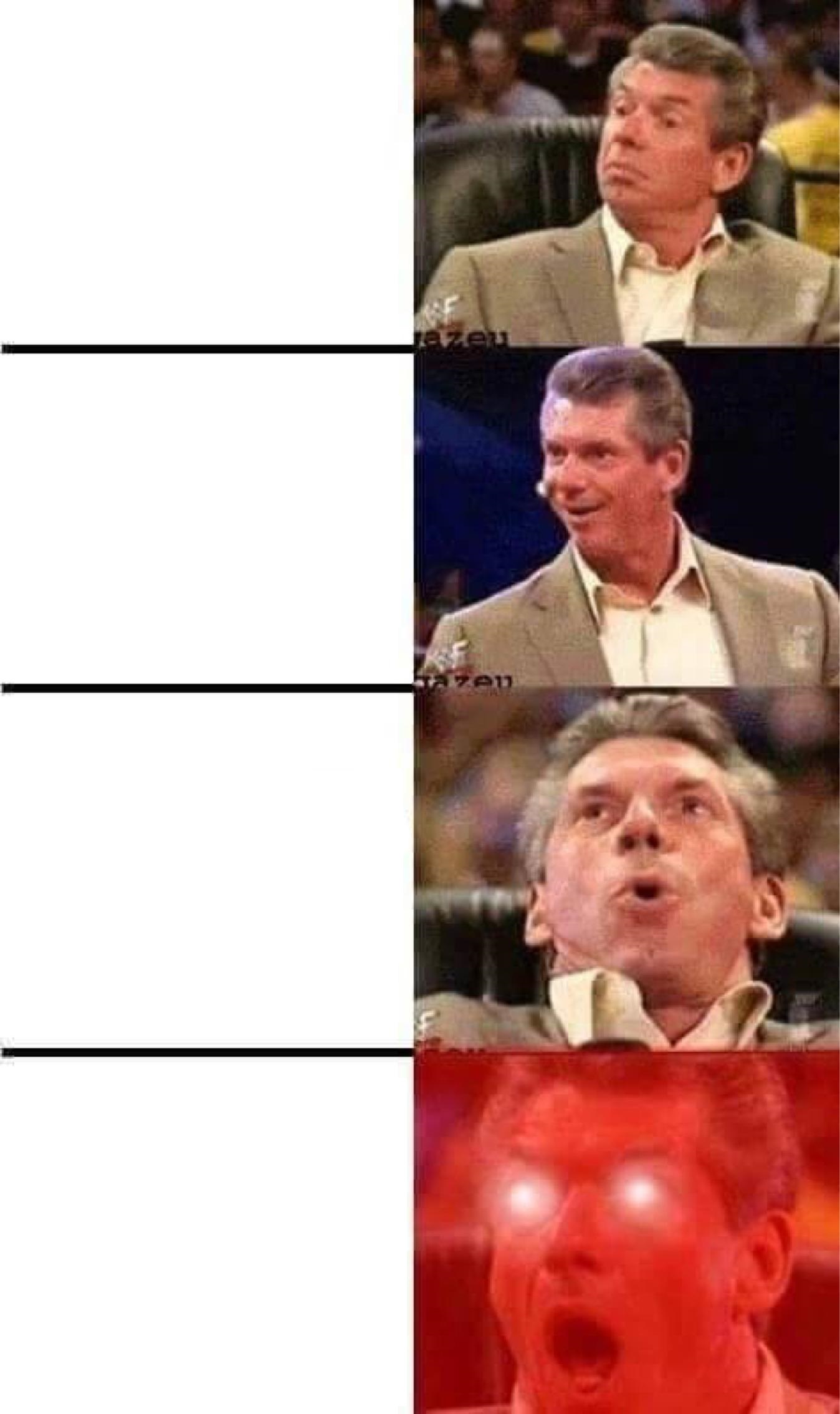
Let’s get this out of the way: Vince McMahon is a terrible person. But, the Vince McMahon Glowing Eyes meme is really excellent. You probably know it and know that it builds from a modest claim to a more exciting one to even more exciting ones, leading to McMahon’s Glowing Eyes.

In 2022, I was on the job market and decided it was time to take a very different rhetorical approach to my job letters. What I had noticed over the years is that academic job letters often start with broad topic sentences and then follow them with ever-narrowing sentences that provide finer details to support the topic sentence. A broad sentence about a project that makes it really appealing is then followed by a series of sentences that provide detail that make the project seem increasingly less interesting (unless the reader is really familiar with relevant details). Here are two paragraphs, from successive iterations of a job letter, that cover the same ground:

My scholarship largely falls into two streams that intersect around questions of embodiment, temporality, and subjectivity. One stream draws on historiographic, media-based, and ethnographic approaches to analyze the contexts that make “neurological disorders” objects of concern for scientists, health care workers, patients, and their families. In The Slumbering Masses: Sleep, Medicine, and Modern American Life (2012) and Unraveling: Remaking Personhood in a Neurodiverse Age (2020), my research shows how neurological disorders become sites of profound social and personal transformations for individuals and families as they confront changes to beliefs about personhood, subjectivity, and everyday life in the U.S. In The Slumbering Masses, I show how the history of industrial capitalism shaped ideas about innate human nature—as expressed in sleep and wakefulness—and laid the foundation for contemporary American everyday life in ideas about whiteness and typically abled-bodies. In Unraveling, I demonstrate how attending to communication disorders—autism, aphasia, and deafness—troubles conceptions of subjectivity as principally being based in an individual’s capacity for speech. These assumptions have structured the practice of psychiatry and medicine in the U.S. and shaped social theory in and beyond the humanities and social sciences. Developing a metalanguage of care based on family experiences of caring for disabled family members, Unraveling forwards an anthropologically-informed theory of “affective bioethics” to reconceptualize how institutions can support families in their interdependent relationships. The other stream of my research focuses on speculative practices, particularly in cinematic and literary science fiction and within scientific and medical knowledge production. This work draws on popular and scientific media and focuses on ideas about the future in the context of the Anthropocene and changing dynamics around racism, environmentalism, and capitalism in relation to the articulation of more inclusive and sustainable futures—captured in Theory for the World to Come (2019) and now the basis for a new project on mental health and climate change, discussed below.

My scholarship is focused on histories of contemporary institutions as social technologies, which follows emergent problems through their trajectories as medical, scientific, governmental, and popular concerns. I have developed “the biology of everyday life” as a framework for conceptualizing how capitalism shapes human physiology, social norms, and cultural expectations. This framework helps show how ableism and racism shape scientific and medical understandings of basic processes, like sleep, digestion, and communication, and the technologies that are developed to address their disordered experience. As an analytic, the biology of everyday life provides novel ways to describe the relationships between individuals, institutions, technologies, and society, integrating social and environmental determinants of disease with theories of subjectivity and personhood. In all of my work, I employ interdisciplinary methodologies that are built on ethnographic, archival, and textual analysis. The Slumbering Masses, which won a first book award from the Society for Medical Anthropology in 2013, was the first book-length social scientific study of sleep in the U.S. and garnered widespread media attention, including in the New Yorker and academic journals across the social sciences, humanities, and medicine. My second book, Unraveling, recovers the history of the nervous system as a complex system that is physiological, environmental, and social, proposing a model of “affective bioethics” that moves beyond exclusionary forms of bioethics that marginalize disability perspectives. In both of these books, the environmental and social interdependencies of everyday life are brought into relief as determinants of health, disease, and disability, which technologies—from institutions to pharmaceuticals—are developed to remedy.

The first one is from 2021 and the second from 2022. There’s a lot going on in both of them, but the first one is so saturated with content that I have a hard time reading it (and reviewers probably did too). The second one is comparatively breezy, with much more concise and targeted sentences that cover a lot of ground without getting bogged down in details. Those details exist in other places–in my research statement, in this case–and the aim of the cover letter is to get people to want to read those documents. One of my dissertation committee members, Thomas Wolfe, once counseled me that “Job materials are like a Vegas show: Always leave the audience wanting more.” The Glowing Eyes Job Letter is my attempt to try and embrace that at the cover letter level.

I wrote these letters as an associate professor approaching promotion to full, so the letters have ~15 years of scholarship, teaching, and service to draw on and describe–which is all the more reason to try and keep it light in the job letter. I think the same lesson holds for early career letters: rather than start a paragraph with a broad description of a dissertation project and then get deeper and deeper into the details, move to discuss the implications of your research, the points of connection it makes possible, and its broader merits in the field. Save the details for other parts of the application and employ them sparingly, knowing that interested people will have a chance to ask you about them during interviews or campus visits.

Paragraphs about teaching tend to do the same kind of thing: they start with broad claims about pedagogy and end with lists of classes people are willing to teach. Putting that list at as the second sentence in the paragraph and then using it to build out to broader issues related to teaching stops that paragraph from deflating as it goes along.

Maybe it was a fluke that it worked for me! But it might be work experimenting with. Let me know how it goes.

Build Your Dissertation-Writing Superego

I recently ran a dissertation writing workshop for the Society for Cultural Anthropology–and, if you missed it, you can play along at home. The workshop was basically group therapy, and I took turns asking participants the following questions. You can answer each of the questions and compare answers with friends (and maybe with members of your dissertation committee!).

Why are you writing a dissertation?

Who are you writing a dissertation for?

What do you want the dissertation to be?

What would be a successful outcome for the dissertation writing process?

What circumstances would lead you to walk away from your dissertation writing permanently?

What are the three key theories that animate your dissertation?

Who are the three key scholars that you are in conversation with?

Who are the constituencies (subfields, disciplines, etc.) that you are seeking to address in your dissertation?

How will you know that you’ve successfully addressed these theories, scholars, and constituencies?

What chapters does your dissertation have to include? What are the topics, key bits of evidence, and key theories involved in each chapter?

If you have time to write your dream dissertation, how would it differ from the necessary dissertation? That is, what additional chapters would it include?

What elements does a successful chapter include?

What is the right balance of evidence and argumentation?

What makes a bad chapter?

Having a clear sense of the answers to these questions–or even a muddled sense that you can refine over time–and writing them out for reference can be very helpful in providing a resource to check in with and ensure that you’re staying true to the mission.

Here’s an exercise: What nagging experience do you keep returning to in your thinking about your fieldwork? It can be an interaction, an event you attended, an interview, something else. Write up that experience. Try and provide as much detail as possible–and don’t worry about how it fits into your dissertation as a whole. Don’t do any analytic work–just the empirical description of the experience itself. Aim for ~5 pages of content.

Now, swap your write-up with a friend and answer the following questions about their write-up. Compare notes.

What are the key elements that resonate for you in this piece of writing?

What anthropological concerns do these elements relate to?

If you had to make an argument about these elements and their relationship to the evidence at hand, how would you structure that argument?

Given what you’ve read, what else would you like to read–what would help this make more sense, move across scales, or address specific scholarly concerns?

My Most Common Peer Review Suggestions, Compiled

The end of summer always brings a flurry of peer review, as I work through all of the submissions and resubmissions that editors sent to me over summer break. I often find myself making similar suggestions to authors and thought that compiling them might serve as a resource for article and book authors to work through before they submit something for peer review. This is a little geared toward qualitative researchers in the social sciences (and specifically anthropology), but might be generalizable.

Situate your research. Who are you? Where are you writing from? Why are you writing what you’re writing? What’s your comparative framework? I read a lot of stuff that assumes the US as the comparative framework for the discussion, but doesn’t discuss the US directly or assumes that American social forms and cultural expectations are universals. I would guess that my most recommended text in peer reviews is Michel-Rolph Trouillot’s Global Transformations for his discussion of “North Atlantic Universals.” (There are people who read that book and it shapes everything they do; and then there are people who don’t read that book, and…) Beyond that, the critiques of objectivity that came out of feminist science studies in the 1980s are still true and you can’t ignore them by not situating yourself in relation to your research–the effect is that a paper comes across as trying to tell an ahistorical story that might strive toward universalism. All research, whatever its context, is necessarily historically situated and explaining why something is important to research in this moment is critical in framing the contribution of the work to its audience.

That theoretical concept has a more complicated history and set of usages than you’re letting on. Literature review sections don’t give authors a ton of space to develop their engagement with key ideas in the field, but if there are multiple genealogies of a concept, be sure to address each of them and spell out their differences. As an example, I am often reading manuscripts that engage with the affect literature–but they only address one side of it (Silvan Tompkins or post-Deleuzian materialism) and make assumptions about the interconnections between the two schools. The same goes with “relations” and “interdependence” and so many more concepts. I might be especially persnickety, but I imagine that anyone deep in a theoretical literature that you’re engaging with will want some equal time paid to each of the represented traditions of thought–even, and especially, if you disagree with them. Detailing those distinctions is a good way to ensure that one’s contributions are well spelled out. And if you think there’s only one genealogy to a concept you’re using, take the time to make sure!

Diversify your citations, please. It’s well established at this point–thanks to Cite Black Women and Catherine Lutz’s work on the “erasure of women’s writing“–that women and minority scholars are cited at lower rates (and in different ways) than men, and especially white men. Checking one’s bibliography to ensure that there is significant representation of non-men (and non-white men) is a first step toward more inclusive citation practices. Even more importantly, working through the literature review and argumentation to ensure that non-white, non-men are being engaged with as part of the theoretical scaffolding of the paper is critical. This may require reframing the contribution of the paper, but the process of addressing what’s happening in other scholarly circles ensures that the work will reach broader audiences.

The evidence/argumentation ratio is askew. This tends to be a problem that I associate with early publications on a project (which can happen at any career phase). When an author is too close to the project and really swamped by the details, they tend to put too much evidence into a paper and don’t do enough work to motivate the evidence in relation to the argument; when people are on the other end of a project, they tend to put too little evidence in and too much argumentation. In the former case, it seems to be because the connections between the evidence and the argument are assumed by the author and they don’t take the time to clearly detail how the evidence and argument relate. They also tend to put in more evidence than an argument tends to need–in most articles the ratio is probably something like 1/3 argument, 2/3 evidence. This is something that people forget late in a project, when they’ve been writing about something for several years and have come to feel that a claim has become common sense–but still need to provide some evidence for a novice reader. This can all change based on the audience, but as a general rule of thumb, if the introduction is getting too long–or if it’s too short–something is out of whack.

Remember your audience. Do people need to know this? Asking that question about any evidentiary section or discussion of literature is always helpful in reducing the amount of extraneous and digressive stuff in a manuscript. Where you’re seeking to publish something will necessarily shape who your audience is; if it’s a subfield or niche journal or book list, you can make more assumptions about your audience than if you’re submitting something for a much more general audience. Niche audiences will also be more keen on the nitty-gritty of the evidentiary details of your research. You can’t know who you’re actual audience will be, but if you submit something to a general journal or book list, expect to be read by peer reviewers who have no intrinsic interest in the evidence itself, whereas niche reviewers will be more likely to care about the details. As a peer reviewer, I try and make sure I’m wearing the right hat for the peer review project and work to ensure that I’m playing specialist or generalist as needed to make the right kinds of recommendations for an author.

Hopefully these suggestions provide a quick reference for making sure that a piece of writing is ready for peer review. I don’t always follow my own suggestions, so this might also be a reminder to myself to pay more attention to these elements in my own writing… If you have common peer review suggestions you make, feel free to share them in the comments.