Introversion in the Age of Relentless Academic Self-Promotion

I am, by all accounts, a bit of an introvert. I’m awkward at groupings of more than four people and dislike parties of any size. I’ve made a career out of feeling more comfortable around books than people. And, in terms of my career, I’m nervous about every first day of class and don’t like talking about my research and writing in contexts larger than a group dinner (and even then constantly worry about talking too much). I can be comfortable — sort of — in the role of lecturing, giving a colloquium talk, or doing fieldwork, where it’s not about me or I have a performative frame that I’m comfortable with. Even writing this is difficult; if you look at the archives of what I’ve written about in the past, even the personal stuff is pretty clinical in its detachment.
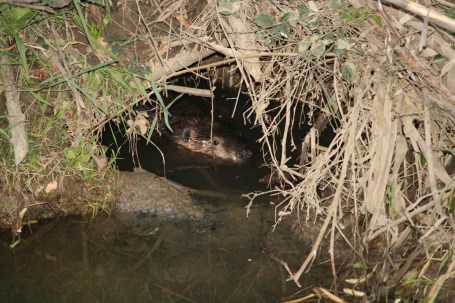
dad-watching-from-the-old-lodge.jpg
That’s a beaver hiding in a lodge. I’ve borrowed this from Cheryl Reynolds and Martinez Beavers.

But I started thinking about my introverted tendencies lately because I found myself writing about myself in two book manuscripts in ways that I hadn’t previously. The first, about neurological disorders, had me brushing up my personal history with dementia and sensory and speech impairments. The second, about speculative fiction and social theory, had me dipping into my past to think about what I was reading, where I was reading it, and why it made sense in its moment. Those experiences, in turn, got me thinking about the intimacy of getting to know an author through the written word, a relationship that’s uneven, but something that I have enjoyed as a reader throughout my life. In the age of social media, that relationship-building seems more apparent on Twitter than it does in books and articles, as the demands of neoliberal self-presentation heighten self-promotion in one medium and performed objectivity in the other.

Around the same time, I was watching an academic friend using social media to promote a forthcoming book. He tweeted several times each day, on and off the topic of the book, and garnered tons of likes and DMs. Knowing him personally, I knew he was more like me than not — a bit of an introvert, but more seasoned through decades of experience. He was able to overcome those introversion tendencies to engage — at least unidirectionally — with interested readers. I bought the book — and I’m sure a lot of his other followers and friends did too — but I’m not sure that I would have pre-ordered it if it hadn’t been for his relentless use of social media leading up to its publication…

Which, in turn, had me thinking back to a conversation with a publicist when my first book came out. She recommended that I open a Twitter account, set up a Facebook author page, and tweet five times each day and post on the Facebook page once daily. I think I managed that for about a week or two before I couldn’t bear to do it anymore. It took me years to not feel bad about failing my publicist in that way, and years more to feel comfortable using blogging as a substitute for the publicity machine that she suggested.

Part of my being okay with my failure at self-promotion is that — like so many academics — I’m not in it for book sales. But I am in the profession for the conversation (and, since I’m what psychologists call “disagreeable,” the arguments too, but those seem harder to find). So when I find myself drawn to self-promotion (usually through Twitter, since self-promotion seems to be 50% of the medium and we’ve collectively agreed to that), it’s usually because I so want to have a conversation about something I’ve just published.

After six months of thinking about this post, I finally committed to write it — not because I felt like I had profound insights into my introverted self and how to manage an ethical and sensible web-presence, but because I didn’t. (The one tiny bit of advice I’ll share, and this is from Jean Langford, is to “pick your fidget” — if you’re going to fidget during a presentation or while teaching because it relieves stress, just pick one thing to fidget with. I empty my pockets and get rid of any easy distractions just in case, which means my fidgeting is usually confined to moving my feet in particular ways.) But I know I’m not alone. So many people are drawn to academic work precisely because they’re introverted, and based on what I can tell from the internet, they seem to deal with the same challenges that I do, albeit with variations. On some level, it’s possible to succeed being an introvert in the academy (since, it seems in a world of introverts, being able to manage one’s introversion is a real asset). On another level, maybe it goes to show how in a world of relatively introverted professionals, a little performed extroversion goes a long way.

That said, whenever I do the obligatory self-promotion that comes with an article, a  colloquium talk, a conference presentation, a book, a podcast — whatever — I still struggle with being uncomfortable about talking about any success, however marginal. Part of that discomfort is based on a deep knowledge of the contingency of any success — from growing up relatively privileged, to the luck of the draw with peer reviewers working out for me, and everything in-between. There’s no mitigating those benefits, other than through their subversion wherever and however I can.

I’ve also come to realize that building intimacy between authors and readers is not just a mechanism for selling books and driving downloads of an article, but also a necessary political praxis. So often it is women, people of color, and minorities who are compelled to give an account of themselves, and white, heterosexual men sit silently by. I have always been interested in the institutional ethnography of the US academy, which this blog has represented, but I’m increasingly interested in the affective qualities of the institution and how it shapes people (hence a new little book about peer review [which, I guess the mention of is a little self-promotional]).

I’m still struggling with wanting to delete this whole post. I’m going to accept that as an indication that I should do the opposite.

What’s it like to be an Associate Professor? (Research University version)

Several years ago, I tried to sum up the perspective I had gained on being an assistant professor at a research university. I attempted to capture all of the things I either wasn’t told in graduate school or didn’t have a real grasp on until I was on the tenure track — and they were largely behind-the-curtain, what-the-job-is-actually-like details, including lots of meetings, emails, and teaching prep-work, alongside the demands of publishing and other scholarly activity. What does the job look like on the other side of tenure? Mostly the same, but there are some important differences.

sisyphus
Sisyphus and his beloved rock (representing institutional demands post-tenure)

The ink was barely dry on my tenure contract when I was asked by my dean to serve in an administrative role. It was probably about two weeks between when I was notified of the administrative approval of my tenure and this request on the part of my dean, which made it kind of difficult to say no to it (but it was really compelling administrative work, so I probably would have said yes anyway). In a nutshell, if the road to tenure is largely anticipatory and structured by tenure demands, the associate professor road is characterized by managing social relationships — with other faculty, with administrators, with students, with colleagues at other institutions, with journal and press editors, with university bureaucrats — many of whom helped on the road to tenure, and are now calling in their debts.

“Debt” seems like a slight mischaracterization, but “favor” also seems too light. These activities can range from work like peer reviewing for presses or journals (especially those you’ve published with) and reviewing grant applications, which I had been doing pre-tenure, but after tenure there was a significant increase in requests. It can also include serving on committees at departmental, university, and national organization levels — and being asked to do that rather than volunteering for it. In addition, there’s serving on ever-more dissertation committees as well as doing tenure review for colleagues at other institutions. Singularly, they don’t seem like much, but taken together, they can be time consuming — and for some faculty, they seem to provide a trajectory while they figure out what their path to full professorship looks like. This isn’t to begrudge these various debts and favors and the people attached to them, but just to note how they pile up — and continue to pile up — and to recognize that strategies need to be developed to handle them maturely.

I’ve been thinking about the non-arrival of tenure for years. After all the stresses around tenure and its quasi-mythological nature, when it happens, it’s actually a slow and drawn out process, which makes it less of a rite of passage and more of a long, bureaucratic process (which is what it is). Between the department vote, the dean’s approval, the university personnel committee, the chancellor or provost, and the president (and regents), there are a lot of not-final approvals (i.e. it’s still not a sure thing). At each stage, the appropriate administrator makes sure to tell you congratulations, but it’s not over yet. And by the time the tenure contract arrives, it has both felt inevitable and had some of the wind taken out of its ceremonial sails.

At least that was my experience. Some of my feelings about the tenure process may be due to the fact that I met my institution’s tenure requirements early and was able to go up for tenure a year ahead of schedule. I’m sure that for people who are in more precarious positions, tenure might come as more of a relief. But in any case, the non-arrival of tenure is also about what happens after tenure.

The assistant professor period is characterized by the project that is getting tenure — there’s real momentum around publishing the requisite amount of stuff, and there’s a deadline. But between associate and full professor, there’s not usually a deadline even when there’s clear expectations (usually doubling whatever it took to get tenure in the first place). Sabbatical is meant to serve as a research period, but it seems like most people use it as a period to reconnect with family and catch up on what they missed during the march to tenure. And unless you’re primed to get to work on the next big research project immediately, it can be hard to use sabbatical to its full effect. For better and worse, things slow down after tenure for a lot of people.

Part of that slow down is bureaucratic and an effect of the job and its duties. Part of it is also just straight up existential. After being told that tenure is the most magical thing in the world, the reality is that the job doesn’t fundamentally change — and, in many respects, there’s less time for research and writing when all of the other institutional demands are factored in. Teaching might be at a new plateau — you might get to the point where you’re teaching the same classes with few or no revisions and can autopilot them. But in my case, I was tired of teaching the same classes and needed to change things significantly (I moved from teaching mostly medical anthropology courses to teaching more general intro and social theory classes). And that meant spending more time prepping classes than I had in several years.

I had started working on my second book before I finished my first one, but like so many people’s second projects, it didn’t work out quite the way I had planned (insufficient funding, lack of dedicated time, difficulty with the IRB, etc.), leading to some redevelopments in the project and some slow down. Because it was a significant shift in focus, it also needed some time devoted to developing new contacts, reading new stuff, and just thinking through the problems of the project — all of which started during the assistant professor phase, but couldn’t really take off until after tenure. I also had a second child, changed institutions, and moved across the country, all of which slowed things down too. For some people, any of those events or aforementioned difficulties might have led to abandoning the project and starting over from scratch with something new — so I can understand why some people take a long time between getting tenure and going up for full professor.

But here’s the other thing: if tenure is marked by its non-arrival, full professorship is marked by its deferral. The difference between associate and full is largely administrative (yes, there’s a pay increase, and maybe there’s some prestige?), meaning that most associate professors are protected from being department chairs or serving as associate deans or conveners of university committees. For some people, it seems like the pay increase isn’t worth the trouble — which is compounded by the difficulties people face in getting a second project off the ground. Maybe we need better incentives, but more likely, we probably need better support to help people have time, money, and space to develop new projects.

This isn’t to diminish tenure — it’s important job security and helpful to have the bandwidth to explore new ideas and projects — but to point out how it isn’t a panacea. In some respects, tenure is integral to the kinds of favors that need to be returned (i.e. with tenure, you can be asked to do things that you can’t be asked to do without it). But the job is the job, and that fundamentally doesn’t change with tenure.

So what do I wish I knew about the post-tenure phase?

1. If you can change when you take sabbatical, wait until you know it will be immediately useful and not for preliminary work (like seeing if a project is viable). Make sure that you have the funds and access to get the data you need, and then use sabbatical time to make it happen.

2. Change your teaching only enough to freshen it up, unless you’re committed to finding a new niche in your department’s curriculum and spending  year or two doing so.

3. Be selective about what you agree to do. Sometimes opportunities quickly become obligations, and there will be plenty of both. It’s okay to say no to an invitation, especially because there will be more coming.

4. Develop small projects that can result in an article or a book chapter. These might be collaborations with graduate or advanced undergraduate students, experiential learning classes, or cannily constructed classes. Steady projects like these help to allay the big existential dread that might present itself in the absence of a second book-length project.

Post-tenure is a strange place. Prepare yourself.

Start Your Own Professionalization Series

When I first started running a professionalization series for graduate students in Anthropology at the University of California, Santa Cruz, my plan was to create a curriculum that could be revisited annually (or biannually, in some cases), and could be arranged modularly. On the quarter system, it meant that we had 10 weeks for each term, and I hosted a professionalization seminar every other week (usually four each fall, and three each winter and spring). The idea was to develop the content and then rearrange it as student demand dictated.

June_30_1917 cr.jpg

In its earliest version, it roughly followed the job market, starting with a session about looking for jobs in anthropology, then writing job letters, a day spent talking about academic CVs, and then a section devoted to practicing conference presentations (since that lined up with the annual meeting of the American Anthropological Association). The winter term was generally focused on teaching, and we had seminars on writing syllabuses, developing assignments, and dealing with problem students. The spring term was devoted to academic writing, and I broke a discussion of writing academic articles into two meetings, the first on the content and form of journal articles, and the second on identifying the right journal to submit an article to. The spring term was a little more of a wild card, and over the years it had sessions on alt-ac careers, translating a dissertation into a book, and preparing for campus visits. What I didn’t cover — and this was because we had a dedicated course for it — was grant writing.

After the first couple of iterations, the students asked that we move some of the job preparation sessions to the spring, so that they could have some more time to prepare for the fall job market. The only challenge was that there weren’t many — if any — job advertisements that we could talk about, so I had to rely on ads I had saved over the years (most of which were quirky, which is why I saved them).

If you know this blog, then you know that most of the posts originated in the conversations that I had with students, and that, over time, I worked to summarize those conversations in the blog posts (or at least my side of the conversation). Once the posts had been written, I asked students to read them in preparation for our meetings, so that we could start with a shared basis for the conversation. That helped to move from meetings where I spent a lot of time seeing what I thought (following E.M. Forster’s “How do I know what I think until I see what I say?” dictum) to meetings where we could have more of a free-flowing conversation about the topic.

Over the years, I started to invite faculty to attend the sessions as well, usually trying to identify either a foil to my perspective (someone from a different generation or subfield or both), or someone who I knew had a special interest in whatever the topic was. I also made sure to advertise the topics in advance and invite the faculty to attend, which often related to their specific professionalization interests. If you’re inviting faculty, it’s really helpful to identify people that have been on the job market recently as well as people who have served on hiring or promotion committees. Those two perspectives — what the job search is like from the applicant and reviewer positions — is really demystifying. Because what hiring committees are looking for has been changing, it’s helpful to have people who are also familiar with promotion requirements, since they have a trickle down effect on search committees.

The one thing I tried to do and was never successful at was getting the faculty who taught the first year foundations seminars to build the stuff we were doing in the professionalization seminar into their courses (e.g. having students turn in a CV after we talked about them in the seminar). I couldn’t even swing it when I was teaching in that sequence, so I don’t blame anyone for that failure — but it would take an extra level of coordination. I think it’s a good idea, but difficult to manage with the changing content of the professionalization seminar and a changing cast of faculty teaching the foundations sequence. My hope was that getting students into the professionalization seminar early would serve to socialize them to the need for professionalization (instead of waiting until they were going on the job market).

So, here’s a plan, boiled down:

Come up with a curriculum. You can follow my Professionalization Materials checklist or come up with one of your own.

Schedule the series. It’s helpful to plan a whole term or semester at a time and to send out the calendar as early as you can. I found that 1.5 hour meetings worked well, although there were times that we could have talked for hours. And planning meetings over lunch made it possible for most people to attend. Please don’t schedule meetings to interfere with people having to take care of their children or after the 9-5 workday (stop academic self-exploitation!).

Invite faculty guests to share their experiences. Try for two for each seminar, and at least one if the convener of the seminars is a faculty member with no more than three faculty in the room (who were specifically asked to be there). Too many faculty perspectives can be confusing. And make sure that faculty know that they don’t have to prepare anything for their visit — they can just show up and answer questions.

Collect relevant materials. It’s helpful to get faculty to contribute CVs, job letters, teaching and research statements, syllabuses, grant applications, etc., to a common folder that graduate students have access to through the university or department. Some faculty can be a little squeamish about this, and in those cases I asked for paper copies that I copied and distributed.

Find some good websites to help guide the conversation. There’s no shortage of people chiming in on these concerns, and toggling between disciplinary and generational perspectives can be really helpful. And since you’re already here, this doesn’t count as self-promotion.

Keep it going. Sometimes there’s a lot of anxiety in a department and that translates into momentum for this kind of thing. But the triage model doesn’t actually help the problem of the continued need to professionalize students for the job market. Just having a regular space and time where students can talk about this stuff is really helpful and can improve morale while demystifying the job market. If you can also provide cookies, then even better.