The Ethnographic Clinic, Part 2: Fleshing Out the Case

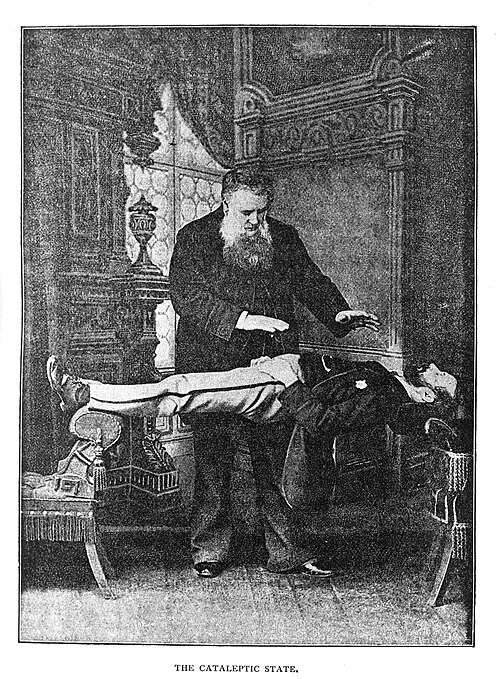
A mesmerist demonstrates the cataleptic state by levitating a man.

In the first post on the Ethnographic Clinic, I described the process of writing up an initial ethnographic case; in this post, I discuss what to do next, given the solicitation of responses from the previous stage.

Here, I offer a method for fleshing out a case by writing forwards and backwards with the contextual cues produced in the presentation of the case to an audience. The primary contextual elements to work with here are the background information that readers need in order to understand the case and other research that you’ve done that resonates with the case you presented. The latter of these two should bring forward other cases in your research that echo the presented case.

Writing Backwards: Providing Context

What does your audience need to know in order to make sense of the case as presented? They should have provided you with contours of their needs in your discussion of the case by asking questions that elicit the kinds of information they needed. There are probably a few immediate concerns to address:

The context of the research: It might be the social context of an event (e.g., where is it happening, who is participating in it, what is its goal?), its calendrical position or temporal occurrence, its relation to other similar events, and the political/religious/cultural role of the event. The key is to conceive of the relations that the case has to its social and historical context and provide a succinct summary of the context that’s necessary for your audience to understand why it’s important socially. In old anthropology language, this is describing the “emic” importance of the case.

The context of the relation: What is your relation to the case? This might be how you came to know an interview subject, the context of that interview, and the geographic situation of an interview. It might be how you relate to an event or interaction or process: are you an observer, a participant, a witness–something else?

The context of the case itself: How is the case like or unlike other similar cases in your research? If it is an event, are there other events like it? What is the genre of those events? How do they proceed? Who is involved? How is this event similar or different from those other iterations of the same kind of event? If the case is an interview or portion thereof, how is this interview like or unlike other interviews? If it is a portion of an interview, how is this portion different than other parts of the same interview? This content is critical to the next step and will require you to write up these contextual materials for inclusion in the next draft.

There may be other contextual elements that your audience needs and the key to working with those requests is to be judicious: limit how much context you provide only to what has been asked for so that your audience can make sense of the case presented. It’s very common for early drafts to include too much information. The challenge with this is that you want your audience to be able to focus on what you’re trying to convey to them and if you’re telling them too much extraneous information, it’s hard to focus on what you want them to know. Finding ways to write less is important, and sticking to what people ask you to explain is one way toward this end.

In the context of longer writing projects (like a dissertation or book), it may be the case that critical contextual elements will be presented in earlier chapters, and that alleviates you from reproducing that context at length in relation to this chapter. Knowing where these other contextual elements occur can help to clue you in to where this chapter should appear in the overall text. For example, if a chapter needs a lot of historical context, it may be best to plan its placement after a more historically oriented chapter earlier in the text.

Generically, this contextual material often appears after the presentation of a case in a piece of writing. In articles, it will often occur in a separate section, usually following the elaboration of the article’s argument and literature review. In chapters of a dissertation, this contextual information might immediately follow the initial case or the interpretive argument about the case. For our purposes, your analytic argument is still being held off until stage three.

Writing Forwards: Providing Resonance

Your presented case likely echoes elements from your other research, which you may have already identified above. You’ll now want to outline those relations to guide your next stage of writing. I tend to think in twos and threes: cases become meaningful to your argument when they’re redundant and when they offer differences from other, similar cases. To make an impactful argument, you want to be able to demonstrate to your reader the importance of the cases you present, and showing them how representative (or distinct) they are is the best way to accomplish this. Work toward identifying cases that you can compare the present case to and outline them, highlighting the points of similarity and difference. Writing these cases out will be essential to stage three.

Your discussion of your case should have elicited ideas about scholarship that you can contribute to, theorists and theories that you might be in dialogue with, and how you might proceed in your interpretation of the case. At this point, you want to collate this material and make decisions about what resonates for you, i.e., are there certain theories that you’re drawn to engaging with or motivated to avoid? Assemble this material into lists: theories to engage with, theories to avoid, scholars to engage with, concepts to incorporate, and concepts to avoid.

With all of this material, you’ve done a lot of pre-writing for the next stage and should be set up for success.

The Ethnographic Clinic continues in stage three.
The Ethnographic Clinic, Part 1: Presenting the Case

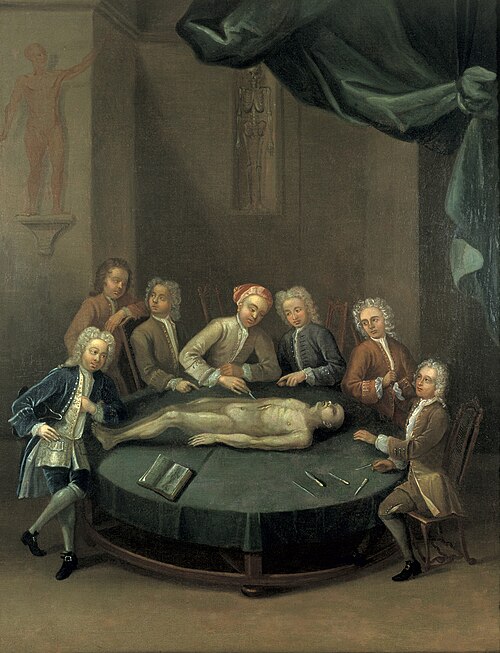
William Cheselden giving an anatomical demonstration to six spectators in the anatomy-theatre of the Barber-Surgeons' Company, London. Oil painting, ca. 1730/1740.

Ethnographic writing is composed of cases. Ethnographers don’t always think that way about their research, but what they are collecting are descriptions of events, processes, and interactions; interviews with individuals or conversations with groups; and reflections on experiences based on participant-observation. Cases can be singular, e.g., a specific, one-off event, or processual, e.g., a series of interactions with someone over time. The trick in ethnographic writing is to clearly isolate cases as cases and then to scale up from an individual case to an analysis that demonstrates the representativeness (or exceptionality) of a case.

I come to this characterization of ethnographic cases because of my time in a teaching hospital, where clinicians and clinical residents presented thorny cases to their shared department in the hopes that they could come to some collective understanding of the case. Often, they presented the department staff with just the facts: what a patient’s symptoms were, what the social context of the patient was, and how the patient had been treated previously and to what effect. Rarely, cases were presented with an anticipated interpretation or resolution; instead, interpretation was something that was solicited from the group.

In that context, I’ve begun to wonder whether a similar approach to ethnographic writing might work: instead of expecting interpretation to come through isolated, scholarly attention to one’s ethnographic research, might collective rumination about other people’s ethnographic cases open up interpretive possibilities and aid in the writing process? Over this and two other posts, I articulate the Ethnographic Clinic as an experiment in ethnographic writing. This post lays out the first stage of this process: identifying and writing up a case (which echoes an earlier post about the 5-Page Dissertation); the second stage scales up from the individual case to contextualize it; and the third stage elaborates how to make an analytic turn to do the interpretive work that ethnographic writing requires.

Step One: Tell a Thorny Story

Every ethnographer has experiences during their fieldwork that stick with them and that they continue to think about without neat resolution. These experiences can be interviews, events or interactions, or observations of practices and processes. For the purpose of the Ethnographic Clinic, choose one thorny story and describe it in as much detail as possible. Withhold analysis. It can be as short or long as needed, with the aim of conveying to the audience only what they need to know to understand the case. Who was involved? Where in the world is it occurring? How do things unfold? The case, to the degree that it’s possible, should have a beginning and an ending, but what that consists of should be determined by the case itself.

The story should be temporally limited. That is, if there is a re-occurrence of the event or interaction, limit yourself to just one occurrence. If it is an interview, it shouldn’t be the whole interview, but only the parts that are key to the case.

Refuse analysis. If you’re tempted to start to explain anything, either contextually or analytically, stop. The aim is just to describe the case. Any analysis will disrupt the next step, so be sure to keep the case as empirically-focused as possible. If you need to, have someone else edit out any analytic or contextualizing work you do.

Step Two: Present the Case

Find a clinic. What that entails is bringing together several other ethnographers who are also working on cases that they can present to a shared audience (that they should also be part of). When you present the case, stick to the text. Then, spend time addressing audience questions and allowing the audience to reflect on the case. It may be useful to have someone else keep notes of this conversation and to audio record it as well. What contextual questions do people have? What do you need to tell them that they haven’t already learned from the case in order for the case to make sense? What kinds of theoretical connections are they making? How are they interpreting the case and to what end? What it is as case of, as far as they understand it, either within your work, their work, or the work of other scholars? Be sure to spend ample time with each case–maybe 30-40 minutes–and to not rush to ready conclusions, but to let the audience respond to the case and provoke your further reflection on the case.

Step Three: Outline Next Steps

From the clinical presentation, you should have a list of contextualizing information that your audience needs, theoretical points of connection and frameworks, and a growing sense of the other research you have done that this case connects to. Organize this as an outline with those three headings: contextualization needed, theoretical connections, and additional research. In the next stage, you’ll focus on the first and third of these elements in order to flesh out this first case. Approaching this outline as an enumerated list of what needs to be done is the most robust approach, as it will help guide you through the next stage of the writing process.

Stage two proceeds from here.

So You’ve Got a BA in Anthropology…

ImageEvery year, graduating seniors are struck with bouts of anxiety when it comes time to think about what to do after graduating. I’m never entirely sure how to address this anxiety — when I graduated with a BA in English Literature in 1998, I went to work as a substitute teacher for a year, first in Ohio then Michigan, which was fun but not ultimately what I wanted to do — but here’s what I tell most students:

1) Most importantly, stay busy. Many students take time off after graduating, but it’s pretty important, both psychologically and professionally, to stay active. It can be really tempting to grant yourself a short vacation upon graduating, but unless you have a job lined up, a short vacation can often become a long one as you go through the process of looking for a job when you return to being active. And it doesn’t have to be your career — a job at your local coffee shop will do nicely, as will some weekly volunteering — but it does need to be something to get you out of the house and provide you with a bit of structure. After 17 or more years of having a life governed by school, a little bit of structure can be a very important thing in fighting off malaise and anxiety.

2) Find a volunteering gig. Idealist.org is a pretty good place to look for both volunteer and intern positions by area; InterAction seems to favor international opportunities. Ronald Hicks maintains a good list of more general internship opportunities for anthropology majors, but it might mean sorting through websites or relocating for a position.Your alma mater probably has a career center of some sort that can help you both with volunteering and an eventual job, and your home department might be able to help with volunteer positions as well.

It might not seem too important to spend 4-10 hours each week volunteering or interning, but: most of the other people in any volunteering gig are usually volunteers themselves, and they have contacts. If they know you through your volunteering, they might be impressed enough to connect you with people who have jobs available or even offer you a job that they have. Or, a volunteer organization might sometimes offer you a job, if you’re a dedicated and thoughtful person and they have a job to offer. Volunteering is really playing the long game: it might not get you something in the first couple of months, but it might turn into something great over time.

3) Start looking for a career. There are many, many job websites on the internet, and I can’t really recommend one over the other. But know that there are plenty of employers that are interested in the kinds of work that anthropology BAs can do; UC Berkeley and the American Anthropological Association both have overviews of kinds of career paths anthropology graduates have followed after graduation. If none of that sounds appealing, there are many programs to teach English abroad, like JET — just google ‘teach english [place you want to live]’ and see what comes up. Some programs seem sketchier than others, so it’s worth sussing them out a bit, but they all seem to pay equally poorly in exchange for you spending a couple of years abroad. There are also opportunities like Teach for America and the Peace Corps. Teach for America gets you teaching in exchange for teaching credentials, whereas Peace Corps volunteers can be asked to do any number of things based on their skills in exchange for pay. Really, there’s no shortage of low-paid, idealistic work for Anthropology BAs to do… But these are the programs that I’ve known former students to have worked with, and they’ve generally benefited from their experiences.

Remember two things: your first job probably won’t be your last job, so don’t despair if you hate it — it’s experience and at the worst lets you know what you don’t want to do in the future. And, secondly, every job is a step towards a career. As you winnow out the things you don’t want to do, as you build professional contacts and skills, you’ll be moving towards being employable in better and (hopefully) better paid positions. This might mean you’re perpetually on the job market, but that’s okay — ultimately, this is about finding a career that you tolerate if not enjoy.

4) Consider a practical Master’s degree. If everything isn’t working out on the job front, take a look at Master’s programs that can help you land a better class of job — M.A.s like Public Policy, Public Health, Social Work, and Education. Many of these programs are 1-2 years long and will cost you a fair amount of money, so look locally and benefit from paying in-state tuition. (Often the degree granting institution doesn’t matter as much as the content of the education, which is usually pretty similar from one institution to another, since it’s a much more practically focused curriculum.) They may require letters of recommendation, but letters from faculty and employers can work; and, some employers will help to offset the cost of your education if you come back to work for them for a while. Or, if you want to go on to get a Ph.D., this can be a way to get fresh letters of recommendation and training that might help you be employed on the other side of your Ph.D.

5) Or you can pursue a Ph.D.

Life after university can be tough and existential crisis-provoking — I only made matters worse by spending my free time reading Borges and Burroughs at my local city park when I should have been reading something more uplifting. Staying busy is essential, as is thinking about the kind of future you want, and working towards it. Faculty aren’t always the best people to talk to about this kind of stuff — we all chose a Ph.D. over other opportunities, after all — but talking to faculty early and doing volunteer work or internships prior to graduation can definitely reduce stress levels after commencement…