The Mentoring Compact

Faculty mentoring of graduate students is one of those things that is rightly the subject of recurrent conversation; there are good mentors and bad, lack of clarity in faculty expectations and student responses, sustainable and deeply-broken models of graduate student training, all of which seem to perpetuate themselves (often unreflexively). The faculty who are best at mentoring recognize that it is a dynamic process, and that not one model works for all students, and, moreover, that the process of mentoring students leads to new techniques and understandings of the process. Sometimes it takes graduate students to precipitate some faculty growth. That all said, this is what I’ve learned in my eight years of graduate study and eleven years of working with graduate students, which I offer as a two-sided compact, what students should do, and what faculty should provide:

That’s Yoda on Luke’s back — maybe as a metaphor of the interdependency of mentor and mentee?

Students: Keep lines of communication open with your adviser and committee. If you’re a graduate student, don’t wait for your adviser or committee to contact you. Instead, make a regular practice of keeping people up to date about what you’re doing and how things are going. I make this suggestion because I’ve found that when things start to go poorly for graduate students (during grant writing, dissertation research, dissertation writing, job seeking, etc.), many students take to not communicating with their committee, often, it seems, out of fear of communicating that things are going poorly. If you send your adviser a monthly email keeping them abreast of what’s happening, it keeps lines of communication open and ensures that when difficulties arise, there’s already a channel open. (Other committee members might receive email every four or six months.) Just answer these three questions: 1) what have you been working on?, 2) what problems have you faced?, 3) how have you addressed those problems? (#3 is a good place to ask for help, if needed.)

Students might worry that sending advisers and committee members emails obliges them to respond, thereby creating unnecessary work for faculty, but it’s okay to preface emails like this with something along the lines of “There’s no need to respond to this email; I’m just writing to keep you in the loop.” Most faculty, I’m sure, will take the opportunity to not respond, but know that faculty are keeping students in mind when they receive emails like this.

(I’ve thought about writing a contract with graduate students, part of which would give them an automatic out of the advising relationship. For example, if you’re my advisee and I don’t hear from you for six months, then I assume I’m no long your adviser. I’ve watched students struggle with taking faculty off their committees, often because the lines of communication between faculty and student are troubled. But I’ve not gotten to an actual contract yet…)

Faculty: Have guidelines for responding to student emails. I tell my advisees that I’ll always respond to an email within 24 hours (unless it’s the weekend or I’m traveling); if I’m a committee member, it’s no more than 72 hours; if I’m just some random faculty member, it can be up to a week. If it’s an actual emergency — and I can do something about it — I’ll break these guidelines. If I’m going to be running late because I want to be thorough in my response, I always make sure to send an email to that effect. That said, I try and abide by a minimalist email policy and send as few emails as possible (if only to have a very clear and direct chain of communication). Only when students start working on their dissertations do I give them my phone number, since I assume that before that the kind of help I can provide is largely bureaucratic (i.e. email and meeting based).

Students: Do what faculty ask you to do. One of the recurrent sources of frustration voiced by faculty who work with graduate students is that students come seeking advice, faculty do a lot of work in making suggestions and providing feedback and resources, and then students don’t follow through by doing what faculty ask them to do. Even if you think the suggestion is off base, it’s better to do the work than to avoid it; showing a faculty member that you did the work and proving that the suggestion was insufficient or off base is a clearer demonstration of the paucity of a suggestion than not taking the suggestion seriously. If you can’t do something, it’s so much better to explain why you can’t than to just not do it (which open lines of communication can facilitate). If an assignment (or job task, like grading) has a clear set of instructions, follow the instructions as provided. Again, it’s better to show the paucity of the instructions by following them than to let faculty think you’re just lazy and trying to find workarounds.

Faculty: Be clear in your expectations and provide instructive guidelines. When I have teaching assistants grading for me, I provide them with very clear rubrics to use; when I am helping students generate reading lists, I’m very clear about how many items should be on it, and what kinds of things those readings should be (e.g. books, chapters, articles, etc.). I find that being very clear in my expectations helps students immensely, and that when they don’t follow the instructions I’ve provided, I can point to the instructions as the basis of our next interaction (see below). I try and take notes of my conversations with students and provide them with a copy of those notes after the meeting (either in writing or via email) so that I know we’re on the same page.

Students: Give faculty lead time to prepare themselves for what you need. There’s very little I find as frustrating as someone else’s deadline being imposed on my work schedule. Having students give me something they’re seeking feedback on shortly before the due date is a case in point: if you want careful reading and generative feedback, I probably need a week to fit it into my schedule and make sure I give it the time it needs. Preparing faculty for upcoming deadlines and the prospect that you’re going to send them something ensures that you get the attention you want. This might be something to communicate in a monthly email (e.g. “I have a fellowship deadline at the end of the month and plan to send you the application in two weeks.”), and is definitely something to give people at least a week or more to prepare for. If it’s big — like a dissertation draft — give them a month or more to prepare for it.

Faculty: Tell students what their windows of opportunity are. I’m pretty regimented in my work planning, and I imagine most faculty are. Because of that, I know — roughly — when I’m going to have more or less time to give students feedback, set up meetings, etc. At the beginning of the semester, I try and give my students a sense of when these windows will be, and try and set up deadlines around them. For example, when I know a student is going to be sending me a dissertation draft, I let that student know when I’ll have a week to dedicate to reading it and commenting on it. If they miss the window, I’ll still get the work done, but I’m clear that it will take me a little longer than if I have it in the window.

Students: Plan to educate faculty on standards and policies. This is especially true for faculty new to your institution or in other departments than your own: faculty tend to not know what the policies are that dictate student lives. If you can provide them with written documentation (i.e. from a graduate student handbook), it can go a long way to clarifying faculty expectations of your work. If standards vary from policies, then you also want proof of that (e.g. if the graduate handbook says comprehensive exams comprise 100 texts but everyone actually does 75, bring some recently defended comprehensive exam reading lists to talk through). Faculty may not vary from the policy as written, but if there is an emerging norm, you’ll want them to know about it and have proof that it exists.

Faculty: Provide a prompt for the material basis for meetings. I find that having some kind of written product to talk through with students makes meetings feel much more productive than not having something to focus on. This can be a dissertation proposal, a grant application, a reading list, an annotated bibliography, an article manuscript, something you’ve both read recently, etc. Having something to focus on ensures that the conversation is well focused and there’s a direct outcome of the meeting. There can be small talk too, but having a clear work plan for you and the student helps to make sure that there are deliverables and that the student has the feeling of being materially supported.

Elsewhere, I’ve provided some guidelines for thinking about how to compose a dissertation committee, and what the overall professionalization timeline might look like given today’s academic job market. The latter might be especially helpful in thinking about the material basis of meetings and to provide a trajectory for the mentoring relationship (at least during grad school). Other tips? Insight? Post them in the comments.

On Having an Ax to Grind

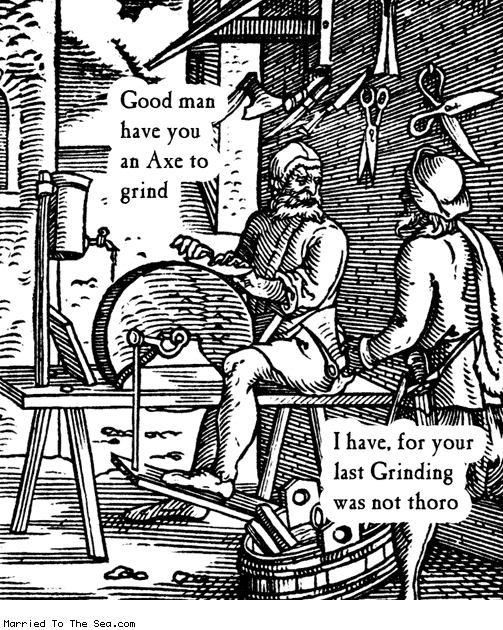
“Productive scholars have an ax to grind.” That was a lesson imparted on me by one of my undergraduate mentors, Brian Murphy. We were walking across campus during my senior year, and I had been talking about the possibility of pursuing some kind of graduate degree, at the time in Literature. Brian was narrating how, despite enjoying the scholarly work he had done throughout his career, he never felt particularly driven to participate in the arguments motivating many scholars in the discipline. (Little did I know that the postmodernism debate was in full rage mode at the time.) Frankly, I didn’t really know what to do with the advice at the time, but I tucked in away.

A man comes to get his ax ground, sometime in the Middle Ages? (From Married to the Sea)

While I was working on the Master’s degree that followed (in Science Fiction Studies at the University of Liverpool), I had things I was interested in, but the work was driven more by curiosity and expediency than having a real argument to make. Over time, the thesis I wrote there developed more of an argument and ended up being publishable as a couple of articles about superhero utopias and the role of law and capital in superhero comics. But to this day, I’m not sure I have much of an ax to grind when it comes to superheroes.

It was while working on revising that content that I received a second piece of advice, this time from Hai Ren, a faculty member I worked with at Bowling Green. Hai suggested that to write a dissertation, one needed “three theorists.” Hai’s point, as I understood it, was that you need some parameters on the ideas that you’re working with, and that having three theorists — who, he suggested, one reads in their entirety (queue up the qualifying exam reading list) — gave a writer the ability to play off differences and consensus between sets of theory. If I wasn’t sure what ax I had to grind, Hai gave me a way to craft one.

I’ve made the same recommendations to students over the years, but I add that the theories that one adopts should really be ontologically compatible. So monists and dualists don’t go together, nor do communists and free marketeers, nor biological determinists and social constructionists, etc. I had started thinking about this after reading Judith Butler’s The Psychic Life of Power, where she draws together Freud, Lacan, Bourdieu, Foucault, Kristeva, Irigaray, Hegel (and others, I’m sure, but memory fails me). Butler’s “toolbox” approach struck me as eliding the profound differences between a thinker like Freud, who really believes in some form of biological determinism, and Foucault, who really does not. You can put them together, but you can’t really build a sound theory out of them because the ontologies don’t fit together. That is, unless you find ways to treat some thinkers as existing within an ontological paradigm developed by others who you take more seriously (e.g. Freud’s use of biology is a form of Foucaultian discourse and not really materially reductive. But I’m skeptical.).

If you go look at the introduction to The Slumbering Masses, I’m pretty explicit about using three sets of theory and having an ax to grind: I’m trying to work through the overlap between Bruno Latour, Bernard Steigler, and Gilles Deleuze & Felix Guattari, and I’m trying to bring them to bear on how we conceptualize the interaction between medicine and capitalism in the U.S. That means, in part, that I’m rejecting medicalization as a way to think about human nature and its interactions with capitalist forms of medicine (which you can read about here).

That doesn’t mean that I’m only working through the theories that come out of those four, white, relatively elite, able-bodied, heterosexual French men. I’m intensely aware of who these men were (and are), and use their monism to engage with other thinkers (especially Genevieve Lloyd and Moira Gatens, two Australian Spinozist philosophers) and the subfield interests I have (especially science and technology studies and feminist medical anthropology). Those engagements helped me suss out things from the theories I was using and guided me through my interactions with those rather large fields of literature. It also gave me a way to talk about things like my “contributions” to the field and the “significance” of my research (scare quotes to denote my general skepticism of that kind of grant-speak criteria). In saturated areas of study, being clear about your theoretical commitments can also make clear what you’re doing differently than other people working on the same topic or area of study.

I try and get students to think about what they believe. Stop thinking through the ecumenical polytheism of graduate study, and consider what kind of world you want to make with your scholarship. What is the ontology that you’re committed to? And who are the right thinkers to join to that project? It shouldn’t just be people that you enjoy reading, but people (and sets of theories) that you fundamentally share a common sensibility with. In committing to a set of thinkers, what differences can you map out between them and how might they guide your interactions with key concepts in your field? That can provide a ton of grist for the mill, both in terms of the initial dissertation, but also in articles and other spin-off projects.

I have other axes to grind — especially around racism in science and medicine — and those too are informed by my theoretical commitments. Having a pretty solidly determined ontological commitment gives me a framework to engage with whatever springs up. And, over time, I’ve changed the people most central to the projects I work on now. But having a set of theoretical commitments helps to guide what and how I read as well as the kinds of questions I ask about the phenomena that I’m drawn to work on.

It took a while, but now I have axes to grind…

Experimenting with Montessori in the College Classroom

When my first child enrolled in preschool, I started to get interested in Montessori approaches to education. As a pedagogical practice, Montessori approaches have largely focused on preschool and elementary education, but there’s a growing interest in finding ways to apply Montessori approaches to higher education — through middle and high school, as well as in the university classroom. In Fall 2018, I taught a small Social Studies of Science and Technology class where I decided to experiment with a more Montessori-like approach. At its heart, Montessori education seeks to instill in students the ability to ask their own questions of the course material, and to facilitate their finding answers to those questions. Rather than impose expectations of content from above through the lecturer-expert instructor, a Montessori approach seeks to create a more symmetrical relationship between the instructor and students. Overall, it seemed to work pretty well.

That would be Theseus following Ariadne’s thread straight into the Minotaur’s lair. A bit of a metaphor, maybe?

The course ended up only having five students (down from a peak of 13), and they were sophomores and juniors, only one of whom was an Anthropology major (which matters only because it was an Anthropology class, ostensibly). I declined to put General Education distributions on the class, which likely kept the enrollment low since students are Gen Ed hungry at my institution. I have a sneaking suspicion that the format of the class might have also turned off some students, especially since my recent experience is that many students just want to be lectured to (hence my experimenting with a format like this). As a result, I thought the class was a little too small, and that a larger class (more like 12-15 students) would have worked better. As it was, one student was really engaged, and most of the other students seemed to be along for the ride… (You can see a copy of the final version of the syllabus here, as well as a list of the guiding questions and threshold prompts.)

This is how I structured the class: We started by reading a book that I hoped would set the tone for the class, and also help the students generate a list of “guiding questions.” That book was James Jones’ Bad Blood, which is about the Tuskegee syphilis “experiment” and the long history of medical and scientific abuses of racialized bodies in the United States. It raises all sort of questions about race, objectivity, data, ethics, media, and methodology, and is written for a pretty general audience. We took a class period to watch Nova’s The Deadly Deception episode, which interviews Jones and brings the book’s project up to date (circa 1993). We then took a day in class to generate a list of guiding questions that would help frame the next section of class. This all took about a week and a half.

As we prepared for the next section of class, we read the Introductions (and sometimes first chapters) of several books — Helen Verran’s Science and an African Logic, Kim TallBear’s Native American DNA, Priscilla Song’s Biomedical Odysseys, Warwick Anderson’s Colonial Pathologies, and Mario Biagioli’s Science Studies Reader. My goals in doing so were to give the students a sense of the breadth of possible topics that might be covered, as well as the shared mission of science studies scholars. We spent a lot of time talking about methods and the citational practices of each of the authors. Who was being cited, how were they being cited, and what specific articles, chapters, or books were being discussed?

That led us to generate a list of author names and readings that we used our guiding questions to shape. As much as we could, we relied on the Science Studies Reader to provide us with readings, which was easy for a lot of the most canonical content (e.g. Bruno Latour, Michel Callon, Donna Haraway, Sandra Harding, etc.). It also led us to select readings from the Science Studies Reader that I normally wouldn’t have picked, but which made sense given our guiding questions. Toward the end of this section, we again took a day to generate a list of updated guiding questions, which revised the earlier list with some nuance and added several new questions.

At this point, the students had their first assessment, a written Threshold assignment. Each of the Thresholds — and there were two more throughout the semester — posed a big question and asked the students to pair guiding questions to it in the search of an answer. Students were free to use any of the course materials from the preceding section by way of providing their answer, and could pair the guiding questions in any way they wanted to. Over time, they had more and more guiding questions to draw from, and at only one point did I ask them not to use a specific guiding question (because they had all used it once already) in a Threshold paper.

Since I had demonstrated to them how to go about finding readings associated with the guiding questions (through our citation tracking), the next section of the class was curated by the students. They picked guiding questions they wanted to seek answers to, and I paired them together based on their shared interests. In a larger class, the groupings would have been larger, and this section of the class would have lasted longer. Each student was responsible for presenting a reading to the class, and they could draw on any of the books we had on hand, as well as articles and book chapters they located through library searches. The result was way more diverse than I would have ever planned — they picked scholars, topics, and readings that I had never encountered.

The presentations — like all student presentations — were a mixed bag. But when I needed to, I intervened to keep things on track and get students to think about the connections between the stuff they had picked and the other course content. And throughout the course, I sometimes stepped into the role of lecturer, especially when they were encountering difficult content for the first time. This didn’t stop during the presentations, but I tended to use my interventions sparingly and definitely let students feel the pressure of being underprepared.

Because the group was rather small, the time I had set aside in the syllabus for student presentations was too much. As we approached the end of the student presentations, I asked the students what they were curious about and we generated a list of topics. It ended up resolving into a section on bodies as epistemic objects, and we covered a wide variety of kinds of bodies, from the microbial to the human to the planetary.

Opening the class to student curiosities — and supporting their labor — definitely resulted in a different class than I would have planned on my own. That said, in many ways the kinds of questions and answers the students generated were along the lines I had hoped they would be, but the ways they chose to get there varied (especially in terms of the readings they chose). A larger version of the same class would have probably been much more dynamic. I doubt such an approach would work for a class larger than ~25 students, but maybe…? If you experiment with classroom approaches like this, let me know — I’m really curious about how it might be refined.