From Dissertation to Book, Part 1

This is the first in a two part sequence of posts on the dissertation-to-book process. The second installment discusses the behind-the-scenes processes that occur once the book is under contract and being prepared for publication and is available here.

A lot of recent graduates feel like the first thing they need to do once they get their Ph.D. is to turn their dissertation into a book manuscript and to get it under contract. This often means dropping everything, and working assiduously on the book manuscript and book proposal. I did; I shouldn’t have. My first book proposal was all wrong, and my thinking about the book version of the dissertation needed a lot more time to mature. That being said, if an editor gets in touch with you and wants to talk about your book, you should do it. It’s a low pressure situation: they want to know what it’s all about and when it might be ready for peer review. Chatting with them can make sure that they remember who you are and look forward to your eventual book proposal. But before you get to the proposal, here’s what (probably) needs to happen:

First, get a couple articles out for review, for two reasons: Getting feedback on your ideas from your peers (who aren’t your dissertation committee or people you’ve known in your grad program, which can often be an insular world of ideas) helps to expand your thinking about your material. And publishers want to see that your peers take your work seriously — so having a publication or two on your CV when you send it in with your book proposal is pretty important. So, really, the first thing you do out of your Ph.D. — if you haven’t already — is to get a couple publications out into the peer review process. (Check out the professionalization timeline to plot this stuff out in advance.)

Since you’ve been living with your dissertation in a pretty intimate fashion for a number of years, it’s also a good idea just to spend time away from it. Give yourself a year to work on a new project or develop some new syllabuses — you might need this time to prepare for a new job anyway, and explicitly setting it aside can be psychologically less stressful that taking that time off and feeling like you should be working on your book. When you come back to the dissertation, you might feel a little less tied to it in its current state, and be ready to mold it a little differently.

Now, when you do get back to the dissertation to turn it into a manuscript, there are some things that surely need to go: Long literature review sections need to be cut out in their entirety, although parsing them out and putting them in as end notes is a good first step, since some of this content is important to retain. Long discussions of theory needs to be cut as well — it might have been important for you to write, but it can moved into the end notes now. Incidental, orienting discussions of theory can still be useful, but for the most part, most theoretical discussions can be cut. If you have whole chapters that fall into the lit review or theory review realms, they might be excised — and with revision — sent to area studies or theory focused journals as articles.

The logic behind these cuts is to really highlight your work — your empirical and theoretical contributions to the field. And this is really critical for developing your book proposal.

Book proposals are rather mysterious things — when I wrote mine, I couldn’t find any really detailed guidelines online, and the people I asked for proposals from had proposals that were a few years old. Like anything related to the academy, the genre is in flux, but there seem to be some constants. From a few conversations with editors over the last few years, this is what I gather they should be: First, they should be no longer than 2 single spaced pages (with normal margins). One editor described them to be as ‘morning coffee documents,’ i.e. an editor should be able to read through a stack of them over morning coffee. Secondly, it needs to lead with your contribution, not some juicy anecdote (as you may have been trained to lead with). When you think about it, it makes a lot of sense: every project has at least one juicy anecdote, but not every project makes a clear contribution to the field (or they might, but authors might not be able to articulate them yet). Seeing that an author knows their contribution sets a proposal apart from the juicy anecdote types. And, third, the proposal needs very, very short summaries of each of the chapters — like 2 sentences each. The editor should walk away from a proposal having a good sense of what the book is about, but they don’t need to know all of the empirical or structural detail. And bear in mind that most book manuscripts are about 100,000 words long, give or take 10,000 words, and you may need to cut or add to get the book to that length.

Now, in thinking about your contribution, there might be some major changes to your manuscript. Many dissertations are written — explicitly or not — as case studies. They’re rather narrowly focused, and the contribution they’re making is usually to a circumscribed literature. It might not feel that way at the time, but it’s often the case. What many books need to do is realize the more general contribution to the discipline that they make. So if your dissertation was about England, it now needs to be about Europe; or if it was about sleep (as in my case), it needs to be about medicine. Most of this work can be done in the new Introduction you’ll be writing shortly… But it also needs to be captured in the proposal. More than anything else, this is the thing that I find people struggle with. And, as I mentioned above, getting some peer reviews and taking some time off from the manuscript can really help you to see its contents differently. It may also mean doing new research to expand the scope of the manuscript; so, if you’re moving from England to Europe, it may mean doing new research to be able to sustain that transition.

I often tell people that I didn’t know what The Slumbering Masses was about until I was nearly done with its second set of revisions. Which leads me to my big caveat for this entry: I didn’t get my first book under contract with a blindly sent proposal; an editor contacted me about seeing the manuscript based on a conversation he had with a third party who knew my work. He rushed the book through peer review — from my perspective, at least (I wasn’t really ready to send it out, since one of the chapters was only half complete). But I got great reviews back from reviewers that knew it wasn’t a final manuscript, and responded to their reviews in my first round of revisions. When I sent it back, it was a very different manuscript. I don’t think more than 2 pages were the same… And when it came back with more comments, I was able to turn them around relatively quickly to make the final version of the book. So when I say I didn’t really know what the book was about until the last couple months of final revisions, it was that I wasn’t entirely sure of all of the contributions it was poised to make. And once I realized them, I just had to align some of the content differently.

I should also say that I don’t know a single person who has gotten a book contract from an unsolicited book proposal. (If you have, let me know your story.) My editor asks me with some regularity if I know of any interesting books-in-process, and I send him lists of names; I imagine many people have this kind of relationship with their editors. So it’s really important to make sure that the people you know who are getting books published know what you’re working on and what it really looks like — not the five second summary they often reduce your work to.

If you have specific questions about anything related to early stage book manuscripts, post them below and I’ll either address them in comments or in a future post.
On the Evolution of Sleep

This was originally posted over at the UMN press blog.

Have humans evolved to sleep in a consolidated, nightly fashion, or is this some kind of social construct that we’ve fallen into? There’s a nice write up on the evolution of diurnal behavior in humans by Cris Campbell, in which he uses my recent article in Current Anthropology to think about the relationships between economy, society and sleep. I’m no hardline social constructionist by any means, but I’m sometimes concerned that evolutionary approaches to sleep can be fairly reductive. And one of the dangers of being biologically – and naturally reductive – is that we can come to accept things like American capitalism as the natural outgrowth of a particular pattern of human behavior, which I write about extensively in The Slumbering Masses. Some kind of middle road between biology and society is necessary to really see how sleep is being shaped by social demands and how it impacts our biological well-being. It sounds so reasonable, but it can come across as a little radical when I tell people that there’s no absolute human nature that determines our individual and collective actions, which is the basis of my argument in that Current Anthropology piece.

Rather than thinking of nature and nurture as absolute determinants of our behavior, it’s more appropriate to think of any individual behavior or social form as existing on a continuum between nature and nurture. That is, everything is somewhat natural and somewhat cultural (and sometimes what we say is natural is actually cultural). And sleep is a great example of this: yes, we all have a natural, physiological urge to sleep, but how each person – and each society – organizes sleep varies, based on cultural norms and individual preferences. For some, this can mean nightly, consolidated sleep in an eight-hour chunk; for others, it might mean biphasic sleep – breaking sleep into two (or more) blocks of sleep, arranged throughout the 24-hour day. So our sleep styles may have developed out of evolutionary selection, or it might be a little more complicated.

Biological anthropologists agree that niche construction can often interfere with (for better or worse) the process of evolution. Roughly, they mean that organisms of all sorts (including humans) can change their environments to maximize the possibility of their survival – think beavers building dams, which changes the local ecology both for the beavers, as well as for the other animals, insects and plants that are part of that environment. Humans, the usual argument goes, are niche constructors without parallel, having built complex societies, agricultural infrastructure, and cities. The assumption in much of the niche construction literature is that niches are positive – at least for the constructor. But humans may be able to build niches that are actually unhealthy for us. If humans evolved to be biphasic sleepers, our pattern of consolidated activity throughout the day may be a very good example of a niche gone wrong.

The niche that Americans have built, slowly over the last 200 years, as I talk about in The Slumbering Masses, is one that consolidates our daily activities into one block in the day (say the 9 to 5 work schedule, alongside the 8 to 3 school schedule), followed by a period of recreation – usually taken up by dinner and nightly television – to be followed by our consolidated sleep. All of which begins again the following day, unless it’s the weekend. This kind of niche isn’t a byproduct of some inner nature, but rather a piecemeal construction that we’ve invested in over centuries of social development. And, if we look elsewhere, there are other models – including societies that favor biphasic or daytime sleep.

If we’ve developed a social structure based on our evolutionary desires for sleep, we could expect to generally not feel sleepy throughout the day and rarely see cases of insomnia. Since 30-40% of Americans claim to experience insomnia symptoms with some regularity, and there’s a booming industry in alertness-promoting chemicals (drugs like Provigil, coffee, soda, tea, energy drinks, etc.), it would seem like our niche doesn’t really meet our needs. At its most benign, it might mean that we consume more caffeine than we should; but it might also be that the niche we’ve built is incredibly difficult for many to conform to, leading to experiences of sleep disorders.

There’s at least two dangers in assuming that our contemporary social structure is based on our evolutionary preferences. First, like I mentioned above, it naturalizes things like capitalism as inevitable outcomes of our selected-for behavior, which I discuss in that Current Anthropology article, as well as in The Slumbering Masses. Secondly, it means that disorderly sleepers aren’t just pathological and in need of treatment, but evolutionary aberrations or throwbacks. That might sound a little silly, but similar ideas have been the basis for racism throughout history; as genomics provides a basis for our understandings of ourselves and others, we may also be facing a future of gene-based discrimination, not entirely different from Aldous Huxley’s Brave New World (which I also mention in that Current Anthropology piece).

Now, it may be that through this niche construction, we’re slowly selecting against people who don’t sleep in accordance with it — but with such a large, complex society, that’s unlikely to happen. One of the neurologists I know once said that our brains work best with a cup of coffee in our system. It’s a strange fantasy to imagine that we evolved over time through the selection of individuals who respond well to caffeine. Rather, it’s an accidental correlation between our physiologies and our lifestyles that leads us to really thrive on caffeine (for those of us that do).

It’s a lot safer to recognize that evolution isn’t purposeful in all of its selections; some selections are accidents, although they can be beneficial. What we can select are the social models that govern our lives, and other models are possible, as organizations like the Take Back Your Time movement have advocated for. And what we should be working towards are social forms that meet the needs of all sleepers, not some or even most. Recognizing that society can be different – and more flexible – also accepts that variation within the human species is non-pathological, and that there might be better ways to think about difference than as disorderly.

The benefits of sharing a bed — with lovers, children, or dogs

Originally posted on the UMN Press blog.

Sure, sharing a bed can be a nuisance from time to time.

And spending the night in a hotel alone while traveling can be a vacation in itself.

But there’s been some recent attention paid to Wendy Troxel’s research with her colleagues on bed-sharing and its benefits, which builds on a decade of research on gender disparities in nightly sleep and who gets what out of sharing a bed with whom. The National Sleep Foundation conducted a survey a few years ago on women and sleep in the United States, and Jenny Hislop and Sara Arber have been conducting ongoing research on women’s sleep in the United Kingdom. A few years earlier, Paul Rosenblatt published a nice, qualitative book on couples’ experiences of sharing a bed, Two in a Bed. According to this varied data, women are more likely to experience symptoms of insomnia and disrupted sleep. It’s not that women are innately predisposed towards insomnia, but rather, according to research, that they’re more likely to be woken up in the middle of the night – to tend to the needs of a child, perhaps, or to be disrupted by their sleeping bed partner, say with a snore or an apnea event.

Infants and toddlers

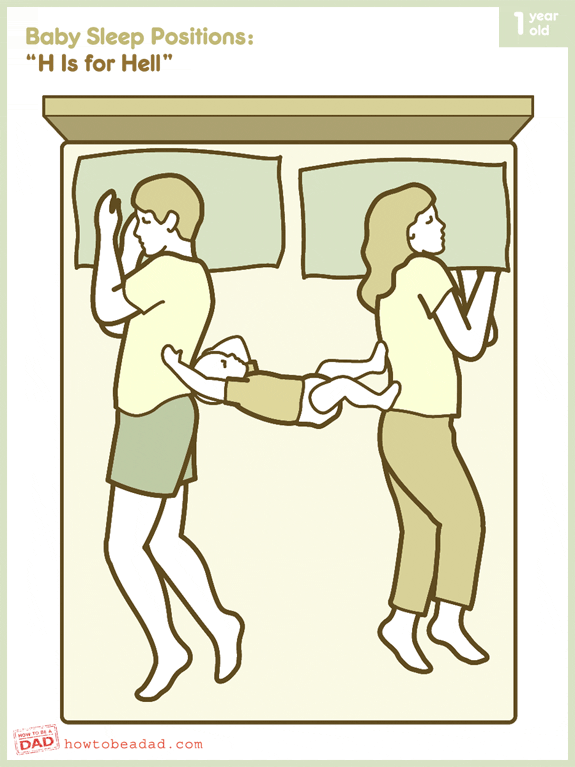
Despite recurrent concerns about sharing a bed with infants and toddlers, there’s also a fair amount of research – mostly from James McKenna’s lab at Notre Dame – on the sleep-related benefits of sharing a bed: co-sleeping parents report getting up to 2 hours more sleep each night than their counterparts who place their kids in separate rooms. This is especially the case for young children, especially while they feed at night; as children age, the benefits of sharing sleeping space decrease. And recent interest in Troxel’s research has been related to her findings that sharing a bed can result in heightened levels of stress-reducing hormones, implying that one of the reasons why we sleep better together is a sense of security – which makes a certain amount of logical sense. If adults get benefits from sharing a bed, shouldn’t young ones receive the same benefits? As I talk about in my book, the fears about bed-sharing usually revolve around accidentally smothering a child, but what evidence there is shows that more children die alone in their cribs than in beds with parents. And for parents who are anxious about sharing a bed, there are all sorts of things to buy to ease their concerns. If you could get 2 more hours of sleep each night and ease your child’s anxiety – and your own – wouldn’t you want to?

Pets

My partner and I have often wondered about the benefits of sleeping with dogs (in part because our border collie-pit bull, Turtle, often shares a bed with us and we want to imagine that we get something out of it more than cramped legs). Does sharing a bed with a watchful canine help our sleep be less anxious in much the same way as sleeping with another adult? Following Donna Haraway’s long-standing interests in multi-species encounters and the mutual shaping of one another’s development, especially in the case of humans and canines, it seems sensible that having a dog we trust sleep nearby might alleviate our nightly need to be vigilant.

This all changes when we move indoors, and to bedrooms far removed from entry doors with locks and alarms, but for many contemporary societies and throughout history, it may be that our co-species investments in dogs have had a lot to do with our desire to sleep without having to keep one eye (or ear) open. A dog sharing a bed might be an alarm system, but in parts of the world where such vigilance isn’t quite so important, they may be a hindrance as much as a help – Turtle is more likely to wake us up when he hears deer in the yard than criminal activity, for example . . . and despite his concerns, the deer are no danger to us.

Couples

All of this follows up on a piece in the Star Tribune on couples that sleep in separate bedrooms. For some sleepers, being at odds a with partner’s sleep behaviors is fairly stressful; larks want to go to bed early, and owls want to go to sleep later. When they go to bed at the same time, owls can lie in bed awake while their lark partner fades off to sleep; and when the lark wakes up early, the owl might be roused by its partner’s activity. Or, larks that go to bed early might be awoken by a late-to-bed owl partner getting into bed. And despite a history of some couples sleeping in separate beds – if not separate rooms – as the article mentions, the marital bed looms large as a normative space that couples seek to inhabit together. This can cause all sorts of tension, but maybe the benefits are worth it.

But if you plan on sharing a bed with a partner, a toddler and a dog (or two), investing in a king-sized bed might become a necessity.

Technology

We don’t always have the option to populate our beds with our kin, and for sleep apnics who sleep with their CPAP and BiPAP machines, they don’t have the option to not populate their beds with machines. For some, as I talk about in The Slumbering Masses, this unwanted bed-sharing can be its own source of stress and tension. What sharing a bed requires – and this is fundamental to sharing a bed with a partner, a child, a pet, or a machine – is some kind of intimate investment.

Sharing a bed with someone or some thing we are anxious about isn’t particularly restful. And when our beds become sites of anxiety and stress, we’re likely to not enjoy going to or staying in bed – regardless of the high-tech features of our chosen beds.

Outside of the bathroom, our beds are one of our most intimate spaces. Who and what we sleep with say as much about ourselves as our relationships in the world.