So You’ve Got a BA in Anthropology…

ImageEvery year, graduating seniors are struck with bouts of anxiety when it comes time to think about what to do after graduating. I’m never entirely sure how to address this anxiety — when I graduated with a BA in English Literature in 1998, I went to work as a substitute teacher for a year, first in Ohio then Michigan, which was fun but not ultimately what I wanted to do — but here’s what I tell most students:

1) Most importantly, stay busy. Many students take time off after graduating, but it’s pretty important, both psychologically and professionally, to stay active. It can be really tempting to grant yourself a short vacation upon graduating, but unless you have a job lined up, a short vacation can often become a long one as you go through the process of looking for a job when you return to being active. And it doesn’t have to be your career — a job at your local coffee shop will do nicely, as will some weekly volunteering — but it does need to be something to get you out of the house and provide you with a bit of structure. After 17 or more years of having a life governed by school, a little bit of structure can be a very important thing in fighting off malaise and anxiety.

2) Find a volunteering gig. Idealist.org is a pretty good place to look for both volunteer and intern positions by area; InterAction seems to favor international opportunities. Ronald Hicks maintains a good list of more general internship opportunities for anthropology majors, but it might mean sorting through websites or relocating for a position.Your alma mater probably has a career center of some sort that can help you both with volunteering and an eventual job, and your home department might be able to help with volunteer positions as well.

It might not seem too important to spend 4-10 hours each week volunteering or interning, but: most of the other people in any volunteering gig are usually volunteers themselves, and they have contacts. If they know you through your volunteering, they might be impressed enough to connect you with people who have jobs available or even offer you a job that they have. Or, a volunteer organization might sometimes offer you a job, if you’re a dedicated and thoughtful person and they have a job to offer. Volunteering is really playing the long game: it might not get you something in the first couple of months, but it might turn into something great over time.

3) Start looking for a career. There are many, many job websites on the internet, and I can’t really recommend one over the other. But know that there are plenty of employers that are interested in the kinds of work that anthropology BAs can do; UC Berkeley and the American Anthropological Association both have overviews of kinds of career paths anthropology graduates have followed after graduation. If none of that sounds appealing, there are many programs to teach English abroad, like JET — just google ‘teach english [place you want to live]’ and see what comes up. Some programs seem sketchier than others, so it’s worth sussing them out a bit, but they all seem to pay equally poorly in exchange for you spending a couple of years abroad. There are also opportunities like Teach for America and the Peace Corps. Teach for America gets you teaching in exchange for teaching credentials, whereas Peace Corps volunteers can be asked to do any number of things based on their skills in exchange for pay. Really, there’s no shortage of low-paid, idealistic work for Anthropology BAs to do… But these are the programs that I’ve known former students to have worked with, and they’ve generally benefited from their experiences.

Remember two things: your first job probably won’t be your last job, so don’t despair if you hate it — it’s experience and at the worst lets you know what you don’t want to do in the future. And, secondly, every job is a step towards a career. As you winnow out the things you don’t want to do, as you build professional contacts and skills, you’ll be moving towards being employable in better and (hopefully) better paid positions. This might mean you’re perpetually on the job market, but that’s okay — ultimately, this is about finding a career that you tolerate if not enjoy.

4) Consider a practical Master’s degree. If everything isn’t working out on the job front, take a look at Master’s programs that can help you land a better class of job — M.A.s like Public Policy, Public Health, Social Work, and Education. Many of these programs are 1-2 years long and will cost you a fair amount of money, so look locally and benefit from paying in-state tuition. (Often the degree granting institution doesn’t matter as much as the content of the education, which is usually pretty similar from one institution to another, since it’s a much more practically focused curriculum.) They may require letters of recommendation, but letters from faculty and employers can work; and, some employers will help to offset the cost of your education if you come back to work for them for a while. Or, if you want to go on to get a Ph.D., this can be a way to get fresh letters of recommendation and training that might help you be employed on the other side of your Ph.D.

5) Or you can pursue a Ph.D.

Life after university can be tough and existential crisis-provoking — I only made matters worse by spending my free time reading Borges and Burroughs at my local city park when I should have been reading something more uplifting. Staying busy is essential, as is thinking about the kind of future you want, and working towards it. Faculty aren’t always the best people to talk to about this kind of stuff — we all chose a Ph.D. over other opportunities, after all — but talking to faculty early and doing volunteer work or internships prior to graduation can definitely reduce stress levels after commencement…
Insomnia? Or Evolution?

Here’s the latest for Psychology Today:

Something woke you up in the middle of the night. The tug of the need to urinate? A bedpartner’s jerky limb? A loud noise? A startling dream? Whatever it was, the event passes as you bring yourself to unsteady consciousness. You lay in the dark for a few minutes — for what seems like a few minutes — deciding whether or not you’re going to get out of bed, if even to go to the bathroom quickly. After another minute of laying in the dark, your bladder has convinced you to go to the bathroom — maybe then you’ll be able to get back to sleep. But once you’re in the bathroom, you know it’s all over. You’re awake. You hadn’t even turned on the lights for fear that doing so would make returning to sleep impossible, but as you fumble in the dark, you know that night has come to an end and your day is starting very early.

The experience is generally referred to as sleep maintenance insomnia. It is characterized by being able to fall asleep when one wants to, but awakening in the middle of the night and being unable to get back to sleep. According to the National Sleep Foundation and drug manufacturers, millions of Americans experience sleep maintenance insomnia on a regular basis. From the perspective of modern science and medicine — and society more generally — this is disorderly sleep. If you wake up after four hours and stay up until the following night, you aren’t getting the amount of sleep you need in order to get through the day. Yet from the perspective of history, being unable to get back to sleep immediately might have everything to do with human evolution.

Humans may have evolved to sleep in a biphasic or non-consolidated fashion, that is, we may be physiologically inclined to sleep in two or more periods over the 24-hour day. We have unambiguous evidence that in pre-industrial Britain and the United States — so before 1840 — that people slept in two periods at night. They would lay down to sleep around sunset or shortly thereafter, wake up around four hours later for a couple of hours, and then sleep again for a few more hours. Today, despite pressures to stop doing so from some quarters, napping cultures thrive in southern Europe, China, Taiwan and elsewhere — people sleep for several hours at night and supplement this sleep with a hefty nap during the day, upwards of two hours.

Sleep is comprised of a series of cycles, which last about two hours for most people. During each cycle, we move through non-Rapid Eye Movement and Rapid Eye Movement (REM) sleep. At the end of each cycle, we move towards wakefulness, and this is when people often wake up. When we wake up in the middle of a cycle — due to an alarm clock or emergency — we often feel terrible throughout the day, struggling with an unresolved sleep cycle. (Incidentally, there are now alarm clocks that detect your progression through a sleep cycle and wake you up at just the right time.) When we think about this from the perspective of evolution, waking up every couple of hours to check your environment is a pretty useful adaptation — sleeping deeply through the night puts one at risk of nocturnal predators. But modern society favors consolidated sleep, so those of us who still sleep as our ancestors did are at risk of being diagnosed with sleep maintenance insomnia.

There aren’t any drawbacks to sleeping in a less consolidated fashion. Some evidence suggests that the grogginess we experience upon awakening is lessened and that we wake up more easily when we sleep for shorter periods. But society is structured around consolidated sleep — as I discuss in The Slumbering Masses, very few employers offer onsite napping facilities — and spending 12 to 14 hours in bed each night would cut into work and family time. And so, even though biphasic sleep might work for us physiologically, it might not work so well socially.

This is why sleep maintenance insomnia is treated as a sleep disorder and not normal human variation: it’s disruptive to society. It can be a nuisance to individuals as well — being chronically sleep-deprived can lead to serious social and health problems — but it wouldn’t be such a nuisance to individuals if society was set up to allow for people to sleep the ways they want to. American sleep patterns are more indebted to our ideas about the workday and school day than any basis in human nature or evolution. Some sleep disorders are serious and benefit from medical attention. But people who experience sleep maintenance insomnia might benefit more from a midday nap than a pharmaceutical fix or a large coffee. It’s up to us all to think about how society might better reflect our needs for sleep — to invent social arrangements that benefit us rather than pharmaceutical companies and the corner Starbucks.

But I’m Not Sleepy!

Here’s the second Psychology Today blog post:

One of my strongest memories from high school is the feeling of that extra hour of sleep when we fall back into standard time each autumn. After the first few weeks of school, and the mounting sleep debt of having to wake up at too early of an hour, having that extra hour of sleep felt exquisite. But the eventual transition back to Daylight Saving Time in the spring was excruciating. Losing that hour of sleep made school much more difficult – at least until my urge to sleep aligned with Daylight Saving Time. My circadian rhythm was generally not the same as the one that I needed to get through the school day without feeling sleepy. This situation made very apparent to me that it’s arbitrary when we start school and work, and that my need for sleep was often at odds with those decisions.

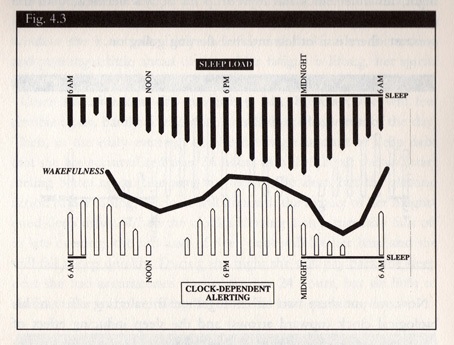
Our circadian rhythms are the result of complex interactions between our body and our environment, and are generally seen as the force that cues us to feel sleepy. On one side, we have the urge to be awake. On the other, the need to sleep. When one overtakes the other, sleep or wakefulness ensues. As we sleep, the need to sleep reduces, and our alerting functions take over – until the need for sleep builds up again and we head for bed. Scientists have suggested that circadian rhythms govern much more than our need for sleep, including our urge to defecate and our appetites. We can delay our need for sleep – or eating or defecating – temporarily, but we can’t defer it indefinitely.

In his book, The Promise of Sleep, William Dement recounts the case of Randy Gardner who stayed awake for eleven days – but we now know that anyone who stays up for too long starts to microsleep as their need for sleep forces them to rest, even while their eyes might be open. As much as we might fight it, our circadian rhythm shapes our sleep.

Many people would tell you that our circadian rhythms are innately tied to the environments we’ve evolved in, but that’s not strictly true. Over the millennia that humans have evolved, they’ve inhabited a number of diverse environments around the globe, all with their own light cues – in circumpolar regions, humans have lived in periods of prolonged night and day; in equatorial regions, humans have been exposed to roughly equal periods of night and day. Sleep, in both of these environments – and all of the environments in-between – has developed as both a social and biological response to these cues. We sleep when we’re tired, but we also tend to take to our beds when the nights are long and we have limited light and heat. This has resulted in a wide variety of sleeping schedules – from societies that favor a midday nap to those that favor a long night in bed. And, then there’s the United States, that tends to favor a short night in bed – eight hours or less – and no midday nap, except for the very young and the very old.

If you were to measure the circadian rhythms of people throughout the world, you should find that there are a wide variety of expressions of circadian cues. But when we look at the science of sleep, one representation of circadian rhythms prevails, and it often looks like this – which I’ve borrowed from Dement’s Promise of Sleep, and which I talk about extensively in my book, The Slumbering Masses:

This model is based on individuals sleeping for eight hours at night – from 10 p.m. until 6 a.m. But what if that individual took a nap in the middle of the day? Her sleep need would decrease accordingly and start to rise again. At bedtime, her sleep need would be less, but still enough to get to sleep. Or, if she slept in two four-hour blocks throughout the day, the need would be more balanced, and never so great that her urge overtakes her need – she wouldn’t just spontaneously fall asleep while in a meeting or driving home.

If we consistently slept in different patterns, our circadian rhythms would look quite different – both because of how we slept, but also because of other environmental cues, like food and light. Humans have evolved to have flexible circadian rhythms, and beyond just patterning of sleep shaping our rhythms, our exposure to light and our consumption of food shape our urges for sleep. This is one of the keys to understanding jetlag: when we go from one set of environmental cues to another, our bodies often react negatively, with our cues for sleep being mismatched to environmental cues. Only after we adjust to the new patterning of light and food intake do we begin to adjust to the new time zone, and our sleep follows suit. This can take a while, in part because our adjustment to food intake can be rather slow, whereas light impacts us quite quickly. Adjusting to Daylight Saving Time is often no big deal, because it’s a slight variance in time and we adjust our schedules accordingly. But adjusting to a bigger time difference – a few hours or more – can often leave us with a serve sense of being dislocated in time.

Despite the relative flexibility and variation of circadian rhythms, the models we have of our biological cues are fairly rigid and are based on the assumption of nightly consolidated sleep and large meals throughout the day. If we slept in two four-hour blocks, or one nightly block supplemented with a daily nap, our rhythms would alter. If we ate smaller meals throughout the day as well, our rhythms would again look less dramatic in their highs and lows. But such an organization of sleep and eating would depend on us investing in a much different ordering of society. The result would both be a dramatically different experience of sleep for us – as individuals and as members of society. And it would change how we conceive of normal and pathological sleep. What we now think of as sleep disorders – narcolepsy, insomnia, shift work sleep disorder – might not be so pernicious and in need of medical treatment.

But changing society to ease our discomforts around sleep seems unlikely – if it’s ever going to happen, it’s going to depend on denaturalizing our conceptions of human circadian rhythms and to take seriously how other orderings or society might benefit our biological experiences of ourselves and the world.