The Ethnographic Clinic, Part 1: Presenting the Case

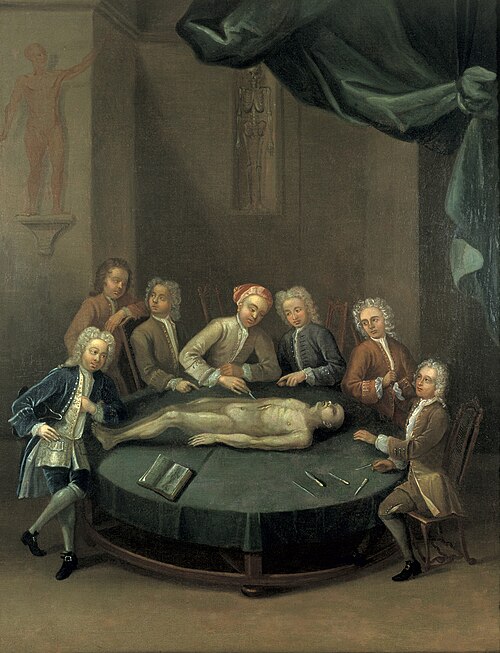
William Cheselden giving an anatomical demonstration to six spectators in the anatomy-theatre of the Barber-Surgeons' Company, London. Oil painting, ca. 1730/1740.

Ethnographic writing is composed of cases. Ethnographers don’t always think that way about their research, but what they are collecting are descriptions of events, processes, and interactions; interviews with individuals or conversations with groups; and reflections on experiences based on participant-observation. Cases can be singular, e.g., a specific, one-off event, or processual, e.g., a series of interactions with someone over time. The trick in ethnographic writing is to clearly isolate cases as cases and then to scale up from an individual case to an analysis that demonstrates the representativeness (or exceptionality) of a case.

I come to this characterization of ethnographic cases because of my time in a teaching hospital, where clinicians and clinical residents presented thorny cases to their shared department in the hopes that they could come to some collective understanding of the case. Often, they presented the department staff with just the facts: what a patient’s symptoms were, what the social context of the patient was, and how the patient had been treated previously and to what effect. Rarely, cases were presented with an anticipated interpretation or resolution; instead, interpretation was something that was solicited from the group.

In that context, I’ve begun to wonder whether a similar approach to ethnographic writing might work: instead of expecting interpretation to come through isolated, scholarly attention to one’s ethnographic research, might collective rumination about other people’s ethnographic cases open up interpretive possibilities and aid in the writing process? Over this and two other posts, I articulate the Ethnographic Clinic as an experiment in ethnographic writing. This post lays out the first stage of this process: identifying and writing up a case (which echoes an earlier post about the 5-Page Dissertation); the second stage scales up from the individual case to contextualize it; and the third stage elaborates how to make an analytic turn to do the interpretive work that ethnographic writing requires.

Step One: Tell a Thorny Story

Every ethnographer has experiences during their fieldwork that stick with them and that they continue to think about without neat resolution. These experiences can be interviews, events or interactions, or observations of practices and processes. For the purpose of the Ethnographic Clinic, choose one thorny story and describe it in as much detail as possible. Withhold analysis. It can be as short or long as needed, with the aim of conveying to the audience only what they need to know to understand the case. Who was involved? Where in the world is it occurring? How do things unfold? The case, to the degree that it’s possible, should have a beginning and an ending, but what that consists of should be determined by the case itself.

The story should be temporally limited. That is, if there is a re-occurrence of the event or interaction, limit yourself to just one occurrence. If it is an interview, it shouldn’t be the whole interview, but only the parts that are key to the case.

Refuse analysis. If you’re tempted to start to explain anything, either contextually or analytically, stop. The aim is just to describe the case. Any analysis will disrupt the next step, so be sure to keep the case as empirically-focused as possible. If you need to, have someone else edit out any analytic or contextualizing work you do.

Step Two: Present the Case

Find a clinic. What that entails is bringing together several other ethnographers who are also working on cases that they can present to a shared audience (that they should also be part of). When you present the case, stick to the text. Then, spend time addressing audience questions and allowing the audience to reflect on the case. It may be useful to have someone else keep notes of this conversation and to audio record it as well. What contextual questions do people have? What do you need to tell them that they haven’t already learned from the case in order for the case to make sense? What kinds of theoretical connections are they making? How are they interpreting the case and to what end? What it is as case of, as far as they understand it, either within your work, their work, or the work of other scholars? Be sure to spend ample time with each case–maybe 30-40 minutes–and to not rush to ready conclusions, but to let the audience respond to the case and provoke your further reflection on the case.

Step Three: Outline Next Steps

From the clinical presentation, you should have a list of contextualizing information that your audience needs, theoretical points of connection and frameworks, and a growing sense of the other research you have done that this case connects to. Organize this as an outline with those three headings: contextualization needed, theoretical connections, and additional research. In the next stage, you’ll focus on the first and third of these elements in order to flesh out this first case. Approaching this outline as an enumerated list of what needs to be done is the most robust approach, as it will help guide you through the next stage of the writing process.

Stage two proceeds from here.

The Future of Anthropology (According to the Bureau of Labor Statistics)

ANTHARCH_jobgrowth

My partner forwarded me a short blog post about job prospects in anthropology looking better than they have been (started by The Atlantic), and we collectively began wondering whether there’s really anything to look forward to. And, the short of it is this: there isn’t. The number of Ph.D.s awarded annually has increased dramatically over the last 20 years (from 341 in 1991 to 555 in 2011, up from 472 in 2006 — a 17% growth) and the job projections at the Bureau of Labor Statistics (BLS) show only a 21% projected growth in anthropology-related jobs. On the face of it, this might look okay, but when we look closer at the BLS numbers there are some things to be concerned about — and to prepare strategies for:

First of all is the actual number of jobs. The BLS lists the number of anthropology jobs in 2010 as 6100, with a total of 7400 by 2020. If the job growth is gradual, with ~160 jobs being created each year, that’s still ~300 anthropology Ph.D.s out of work in their field each year for the foreseeable future. And this assumes that the normal number of retirements continue, providing for the regular entry-level jobs that account for ~100 academic jobs annually (which is about the number of jobs posted annually on the AAA job center).

Second, when you look at where the jobs are projected to be, the BLS shows that most of the jobs will be in ‘professional, scientific and technical services’ (not education, but consulting), and that there will be shrinkage in jobs associated with ‘research and development in the humanities and social sciences’ on the order of 2.5%). The jobs associated with education (at all levels of higher ed — adjuncting and tenure track) only account for about 200 new jobs (if I read the table correctly). There’s also significant contraction in the number of jobs associated with the federal government (maybe related to human terrain work drying up?).

Most of the growth that’s projected is in ‘scientific research and development services’ — which, I’m guessing, means a lot of contract archaeology. Which is pretty much what the BLS says: ‘Archeologists should have the best job prospects in cultural resource management (CRM) firms.’ But, they warn, ‘due to the large number of qualified graduates and relatively few positions available, jobseekers may face very strong competition.’ (But this, I’m going to guess, depends on growth in the U.S. housing market, where archaeologists will oversee holes being dug…) They also shore up my summary, saying ‘job opportunities for anthropologists will expand in businesses, consulting firms, and other non-traditional settings,’ but that these jobs are going to be very competitive.

So, if that’s where the jobs will be, what can we do proactively to prepare for those employment possibilities?

We should probably slow down the number of Ph.D.s programs grant each year. If there’s continued ~20% growth in Ph.D.s granted, the growth projected by the BLS will only keep pace with the number of new Ph.D.s. And unless job growth continues at the same rate, it will quickly be surpassed by Ph.D.s granted (although there must be a ceiling to the number granted, I’m just not sure what that might be — especially since there seem to be more and more new Ph.D. programs… — who doesn’t want teaching assistants?). I’m not sure how Ph.D.s might be limited in the future, but it seems that at the level of the AAA some kind of ‘best practices’ could be developed — which would both ensure a diversity of institutions granting Ph.D.s (so it’s not all elite institutions) and rewards actual success (programs that only graduate 5 students each year, but most of them are employed should be favored over programs that graduate 20 each year and only get 5 employed). But that’s a pretty farfetched possibility… More realistically, students might take to heart the success of programs when selecting where they’ll go, which might lead to the same results, i.e. unsuccessful programs will wither while more successful ones grow.

More pragmatically, programs need to start training graduate students across the subfields to be able to do contract and consulting work, which requires a firm commitment to the professionalization of students that extends past preparing a pretty CV.

Mixed field programs might find ways for graduate students across the subfields to develop collaborative projects, both as term projects, but also as dissertations. Historical archaeologists and cultural anthropologists share many concerns, and teaming graduate students up to conduct collaborative work would prepare them for a future of working on research teams in consulting situations. And cultural anthropologists might think about ways to participate in and contribute to biological fieldwork, with both living and dead populations — which training in science and technology studies might prepare students for. Preparing multi-author papers will help prepare students for the possibility of team-written reports.

Programs might usefully invite local non-academically employed anthropologists for brown bag discussions with graduate students about locating and preparing for jobs in non-academic situations. Most academically employed anthropologists are fairly alienated from these realities, so finding mechanisms to make sure that graduate students aren’t is clearly vital. (If you’re a non-academically employed anthropologist and reading this, you should offer to visit your local Ph.D. granting departments for a brown bag lunch.)

With contacts in local non-academic organizations, students might look towards the possibility of developing local projects (maybe alongside their dissertations) with organizations that already employ anthropologists (Rachel Wright has a nice piece about this in a recent Anthropology News). Whenever I teach our graduate methods class, I have my students volunteer at local organizations — a trick I learned from Penny Edgell at the University of Minnesota. It helps students get their fieldwork feet wet, can result in an early publication, and it also helps them get a sense of how their professional career might involve working in a non-academic setting.

I’m sure there’s more to be done, but the low hanging fruit seems to be finding ways to prepare students for collaborative research possibilities (which cultural anthropology tends not to do, and that’s compounded by the meager funding opportunities that favor solo research) and to introduce them to non-academic employment possibilities. There must be more though — any ideas?