
The Slumbering Masses: Sleep, Medicine, and American Everyday Life was originally published in 2012 (and rereleased in paperback in 2016). The Slumbering Masses focuses on sleep science and medicine in the United States over the course of the 19th through early 21st centuries, and was based on three years of ethnographic fieldwork in a series of sleep clinics in the American Midwest. That fieldwork focused on clinical decision making among sleep specialists, as well as research with local and national patient support groups. My guiding interest in the project was to see how modern sleep (i.e. 8 hours of nightly, consolidated sleep) developed, how it affects clinical practice and the everyday lives of individuals, and how “normal” sleep upholds particular ideas about whiteness, especially as it is related to the spatiotemporal ordering of US society. In addition to ethnographic work on these questions, The Slumbering Masses focuses on a wide variety of media (memoirs, science fiction, children’s book, parenting manuals, etc.); many of the chapters take a mixed methods approach to a question (e.g. sleep & the family, sleep & school, sleep & sports) and draw from ethnographic and textual material to demonstrate the resonance of particular ideas about sleep, how these ideas shape American institutions, and how they inform daily life for individuals with sleep disorders.
In addition to the book, there are a number of articles related to sleep, most of which aren’t integrated into the book (although small snippets are). These include:
Multibiologism: An Anthropological and Bioethical Framework for Moving Beyond Medicalization. Bioethics 34.2: 183-189.
“Human Nature” and the Biology of Everyday Life. American Anthropologist 121.2: 338-349.
with Celina Callahan-Kapoor. Chronic Subjunctivity, Or, How Physicians Use Diabetes and Insomnia to Manage Futures in the United States. Medical Anthropology 36.2: 83-95.
Can we Ever Know the Sleep of Our Ancestors? Sleep Health 2.1: 4-5.
Biomedicine, the Whiteness of Sleep and the Wages of Spatiotemporal Normativity. American Ethnologist 42.3: 446-458.
Myths of Modern American Sleep: Naturalizing Primordial Sleep, Blaming Technological Distractions, and Pathologizing Children. Science as Culture 24.2: 205-226.
Disclosure as Method, Disclosure as Dilemma In Disclosure in Health and Illness, edited by Lenore Manderson and Mark Davis. New York: Routledge, 104-119.
Therapy, Remedy, Cure: Disorder and the Spatiotemporality of Medicine and Everyday Life. Medical Anthropology 32.6: 1-16.
What’s So Natural About Sleep? Anthropology Now 5.3: 9-17.
Where Have All Our Naps Gone?, Or, Nathaniel Kleitman, the Eclipse of Napping, and the Historiography of Emergence. Anthropology of Consciousness 24.2: 96-116.
Natural Hegemonies: Sleep and the Rhythms of American Capitalism. Current Anthropology 52.6: 876-895.
The Nature of Sleep. Comparative Studies of Society and History 53.4: 945-970.
Fantasies of Extremes: Sports, War and the Science of Sleep. Biosocieties 4.2: 257-271.
Precipitating Pharmakologies and Capital Entrapments: Narcolepsy and the Strange Cases of Provigil and Xyrem. Medical Anthropology 28.1: 11-30.
Sleep, Signification, and the Abstract Body of Allopathic Medicine. Body & Society 14.3: 93-114.
You can also read some blog posts I did for Psychology Today, as well as other sundry sleep-related material on Somatosphere.
You can find reviews of The Slumbering Masses here: American Ethnologist, Bulletin of the History of Medicine, Canadian Bulletin of Medical History, Contemporary Sociology, Current Anthropology, Journal of American History, Kirkus Reviews, Library Journal, Los Angeles Review of Books, Medical Anthropology Quarterly, Nature, New Scientist’s CultureLab, and The New Yorker.

Theory for the World to Come is my foray into thinking about life during (and after) the Anthropocene. It draws on speculative fiction (Octavia Butler, Donal Dixon, Stephen Graham Jones, Orson Scott Card, John Wyndham, and more), action movies (Robocop and C.H.U.D.), and a variety of other influences (‘The Twilight Zone,’ George Clinton’s P-Funk). It’s all an attempt to think about the idioms of social theory that attempt to conceptualize the future and the challenges they face in doing so; and it’s an attempt to get people to start thinking about social theory from unlikely or suppressed sources in an effort to build a body of thought that counteracts dominant forms of social theory (which are largely diagnostic and pessimistic).
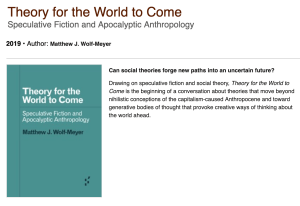
You can read a precis here, in response to a series on Speculative Anthropologies: The Necessary Tension between Science Fiction and Anthropology.
You can read an Open Access version of Theory for the World to Come here.
You can read reviews of Theory for the World to Come here: Continuum: Journal of Media & Cultural Studies, LSE’s Review of Books, Los Angeles Review of Books, Political and Legal Anthropology Review, Science Fiction Studies, and SFRA Review.

Unraveling: Remaking Personhood in a Neurodiverse Age builds on my earlier ethnographic work with neuroscientists and psychiatrists, and adds new research with psychoanalysts and other brain-related researchers to build an alternate history of neuroscience across the 20th century, particularly as it relates to ideas about communication, the person, and subjectivity. I juxtapose my engagements with these sciences of the brain to memoirs of ‘disorders’ of communication — autism, deafness, aphasia — to draw out assumptions about normalcy in mainstream American neuroscience and psychiatry. Unraveling draws on memoirs written by people with communication disorders or their family members and shows how dynamic and idiosyncratic forms of communication are invented and deployed to make atypical forms of personhood and subjectivity possible.
Making Up Persons. Medical Anthropology.
Four Qualities of Care: Situating Disability in Institutional Design and Reform. Disability Studies Quarterly 44.4, n.p.
Subjunctive Grief, a Method. Lateral: Journal of the Cultural Studies Association 14.1, n.p.
Idiosyncratic and Non-Unitary: Disability Memoirs and Antinormative Bioethics. Catalyst: Feminism, Theory, Technoscience 11.1, 1-23.
with Michele Friedner. Becoming Malleable: How Orienting to Disability, Communication, and the Senses further Commits Anthropology to its Moral Project. American Ethnologist 51.1: 78-83.
with John Marlovits. Is a Psychotic Anthropology Possible? Or, How to Have Inclusive Anthropologies of Subjectivity and Personhood. Annual Review of Anthropology, vol 52: 365-380.
Human Centered Design, Bioethics, and Disability Experience. Medical Humanities 49.3: 334-339.
Recomposing Kinship. Feminist Anthropology 1.2: 231-247.
Neurological Disorders, Affective Bioethics, and the Nervous System: Reconsidering the Schiavo Case from a Materialist Perspective. Medical Humanities 46.3: 166-175.
Facilitated Personhood. Journal of the Royal Anthropological Institute 26.1: 167-186.
What Can We Do with Uncertainty? (a response to Des Fitzgerald’s Tracing Autism)
Our Master’s Voice, the Practice of Melancholy, and Minor Sciences. Cultural Anthropology 30.4: 670-691.
with Christopher Cochran. Unifying Minor Sciences and Minor Literatures: Reproduction and Revolution in Quantum Consciousness as a Model for the Anthropology of Science. Anthropological Theory 15.4: 407-433.
You can read reviews of Unraveling here: Ethos, Journal of the Royal Anthropological Institute, and The Polyphony.
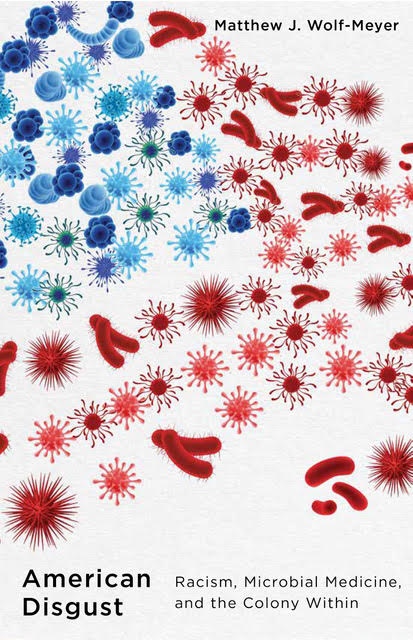
American Disgust: Racism, Microbial Medicine, and the Colony Within started with my interest in why, in 2013, the FDA and CDC were holding public meetings on the use of fecal microbial transplants. It ended up being an exploration of the history of the use of biological material in American biomedicine, which starts in the 19th century ethnological research of George Burke and moves into the 20th century with John Harvey Kellogg’s and Adelle Davis’ work on defining and expanding the American diet. In the present, it focuses on the use (and desire for use) of fecal microbial transplants by people who experience persistent gastrointestinal illnesses, for which microbial transplants are especially effective. Along the way, American Disgust examines how Americans learn disgust as integral to whiteness, reinforce these ideas through our diets and parenting practices, and enact disgust in efforts like the gentrification of diets and the Planetary Health movement. Centrally, American Disgust elaborates “regulation” as a mode of power that scales between microbes, human bodies, and political structures through which the retreat of government regulation of things like food and medicine become something that individuals and communities need to take responsibility for–which often finds its logic rooted in ideas about disgust grounded in racism.
Normal, Regular, Standard: Colonizing the Body through Fecal Microbial Transplants (Medical Anthropology Quarterly 31.3, 2017)
Multitudes without Politics (a response to Ed Yong’s I Contain Multitudes)
Policing Shit, Or, Whatever Happened to the Medical Police? In The Anthropology of Policing, William Garriott & Kevin Karpiak, eds. New York: Routledge, 2018.
You can read reviews of American Disgust here: AAG Review of Books, H-NET, Isis, Metascience, and Sociology of Health & Illness.

Becoming Impossible is my persistent backburner project. Years ago, I published a couple pieces on superhero comics, and I’ve been slowly working on a book manuscript about the impossibilities of the posthuman, which reads superhero comics alongside other posthuman imagery to think about how the posthuman is policed (e.g. how comic book fans respond negatively to things like homosexual superheroes). The two old pieces are:
Batman and Robin in the Nude, or Class and its Exceptions. Extrapolation, 47.3: 187-206.
The World Ozymandias Made: Utopias in Superhero Comics, Subculture, and the Preservation of Difference. Journal of Popular Culture 36.3: 497-517.
Other comic book related material include:
No Superheroes in Hollywood. Los Angeles Review of Books.
There are also occasional articles on U.S. politics, particularly from an anthropological perspective. These include:
American Normal: Situated Theory and American Anthropological Knowledge Production. Journal for the Anthropology of North America 21.2: 44-57.
The Politics of Materiality, or “The Left is Always Late”. PoLAR: Political and Legal Anthropology Review 29.2: 254-275.
 Matthew Wolf-Meyer
2 thoughts on “Publications and Projects”